
Ruth Litovsky, PhD – Slide of the Week
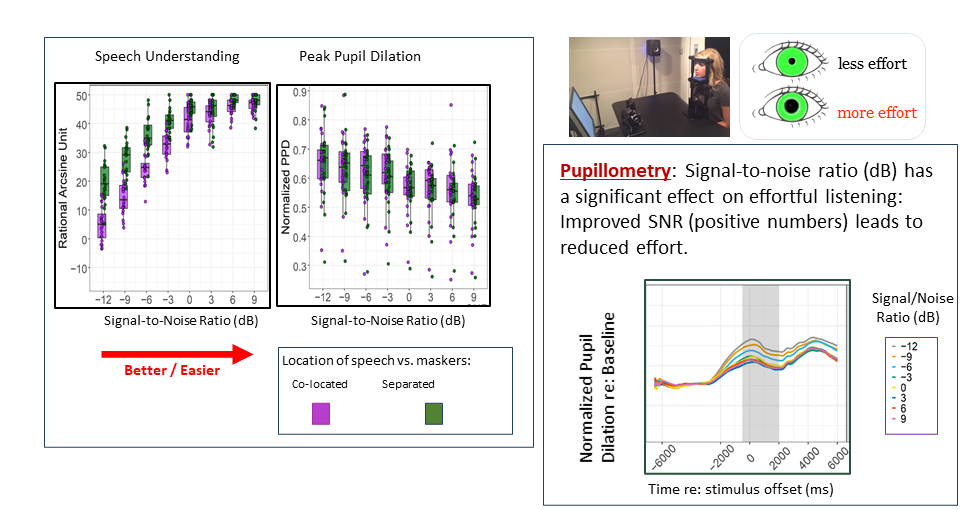
Title: Spatial separation enhances speech intelligibility but increases listening effort
Legend: We studied Cognitive load by measuring both speech understanding in noise and pupillometry (Pupil dilation). Speech in front, and maskers co-located or separated. Spatial separation improved speech intelligibility, without a corresponding reduction in listening effort.
Citation: Tanvi Thakkar, Jarett Knoepke, Stephen R. Dennison, Joseph P. Roche, and Ruth Y. Litovsky. Frontiers in Neuroscience, 10 November 2025. https://doi.org/10.3389/fnins.2025.1655826
Abstract:
Introduction: The current understanding of the cognitive load of listening effort has been advanced by combining speech intelligibility and pupillometry measures. However, the reliability of pupil dilation metrics in complex listening scenarios like spatial release from masking (SRM) remains uncertain. This study investigated how spatial separation of sound sources impacts listening effort (via peak pupil dilation, PPD) and speech intelligibility.
Methods: Speech intelligibility and listening effort were simultaneously measured under co-located and symmetric, spatially-separated conditions at
varying signal-to-noise ratios (SNRs).
Results: Results showed that although spatial separation improved speech intelligibility, it did not yield a corresponding reduction in listening effort. Instead, listening effort increased as SNR became more challenging. Furthermore, test–retest reliability was moderate-to-high for speech intelligibility but only moderate-to-low for PPD, with greater consistency observed at more challenging SNRs. These results suggest that obtaining stable PPD measures within an SRM paradigm may be difficult to achieve.
Discussion: These findings indicate that obtaining stable PPD measures within an SRM paradigm can be challenging. Test session reliability is weak when combining SRM paradigms with measures of listening effort, which may reduce statistical power due to factors such as sample size, number of trials, and sessions tested. This is further limited by the relatively small and homogeneous sample of young, typical hearing adults. Future studies should include a larger and more diverse participant group to assess the generalizability of these results. Clinical trial registration: https://clinicaltrials.gov, NCT02532972.
Investigator: Ruth Litovsky, PhD
About the Lab: Binaural hearing refers to being able to integrate information that the brain receives from the two ears. Binaural hearing is known to help us with the ability to listen in noisy, complex auditory environments, and to localize sound sources.
In the Litovsky lab, we study binaural hearing in persons who have normal hearing and in persons who are deaf and use cochlear implants (CIs). We are interested in whether CI users can benefit from having two (bilateral) CIs and whether, for children, having bilateral CIs at a young age offers unique advantages.