
Remembering Dan Bier, former director of the Waisman Center University Center for Excellence in Developmental Disabilities
by Teresa Palumbo
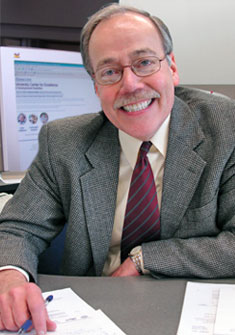
Dan Bier, former associate director of the Waisman Center and University Center for Excellence in Developmental Disabilities, passed away on October 3. He was 78. For more than four decades, Dan worked to bridge research, services, training, and advocacy to improve the daily lives of individuals with intellectual and developmental disabilities and their families. As associate director of the Waisman Center and the University Center for Excellence in Developmental Disabilities (UCEDD) for 16 years, Dan was a steady and thoughtful leader whose influence can be seen across the center’s clinics, training programs, outreach efforts, and partnerships.
Dan’s connection to the Waisman Center began almost at the very beginning of the Waisman Center itself. As a social work graduate student in 1972, he completed his field placement with the center while the Waisman building was still under construction. During that time, he worked in the basement of a nearby office building that housed programs that would eventually become the Waisman Center Clinics. After graduation, Dan worked for the Central Wisconsin Center for six years working in clinical services and outreach, helping families navigate services and coordinating care. Dan then left state service to become executive director of the Wisconsin Association for Perinatal Care, a nonprofit advocacy and education organization focused on maternal and child health. He led the organization for 20 years, building a reputation as a thoughtful administrator, collaborator, and advocate. In 1998, he was recruited back to the Waisman Center by then-director Terry Dolan, who was seeking an associate director to help lead the University Center for Excellence in Developmental Disabilities (UCEDD).
Throughout his career, Dan never lost sight of the purpose behind the work. “The center isn’t a building,” he once reflected. “It’s a focal point, a common activity. If you don’t have that common activity, you don’t really have a center.”
That philosophy guided his leadership. Dan saw the Waisman Center not simply as a place for research, training, clinical care, or outreach, but as a community where those functions worked together. He was deeply committed to translating research into meaningful improvements in people’s daily lives and ensuring that the experiences of individuals and families informed the questions researchers asked. He often described the work as a process rather than a destination. Research informed practice, practice informed research, and families remained at the center of it all. “It still comes back to families,” he said. “It’s amazing how strong families are.”
Among the accomplishments he was most proud of was helping strengthen the partnership between the Waisman Center Clinics and UW Health American Family Children’s Hospital. Working closely with Marsha Mailick, then-director of the Waisman Center, Dan helped establish a more sustainable foundation for the interdisciplinary specialty clinics that have long been a hallmark of the Waisman Center. Together, they navigated changing healthcare and funding landscapes to preserve services that brought multiple disciplines together to meet the needs of children and families.
Dan also helped build and solidify relationships with Wisconsin’s Title V Children and Youth with Special Health Care Needs program, strengthening connections that continue to support families throughout the state.
As a champion of interdisciplinary collaboration, Dan believed the best solutions emerged when researchers, clinicians, educators, trainees, individuals with disabilities, and families learned from one another. He encouraged Waisman researchers to connect with the people whose lives their work would affect and helped ensure that research remained grounded in real-world experience.
His leadership style reflected his humility. Though he played a key role in the Waisman Center’s evolution, Dan often downplayed his own contributions. “I was just part of that process like other people,” he said. “A lot of people could have done these things. I just happened to be there at the right time.”
Those who worked with Dan know that his impact was far greater. His deep understanding of the Waisman Center’s mission, his ability to bring people together, and his unwavering commitment to families helped shape the Waisman Center’s UCEDD. As Marsha Mailick, former director of the Waisman Center, states, “He did great things for the Waisman Center, for individuals with developmental disabilities, and for the Madison community.”
Dan often described the work of the Waisman Center as “exciting work.” For him, it was exciting because it was ultimately about people, families, and creating a better future for individuals of all abilities.
Dan believed passionately in the vision that launched the nation’s UCEDDs more than 60 years ago: a vision that research, training, service, and outreach should work together to improve lives. He dedicated his career to bringing that vision to life. The Waisman Center community remains profoundly grateful for his dedication, wisdom, and leadership that is reflected in the countless lives touched by his work.