
Rebecca Alper, PhD – Slide of the Week
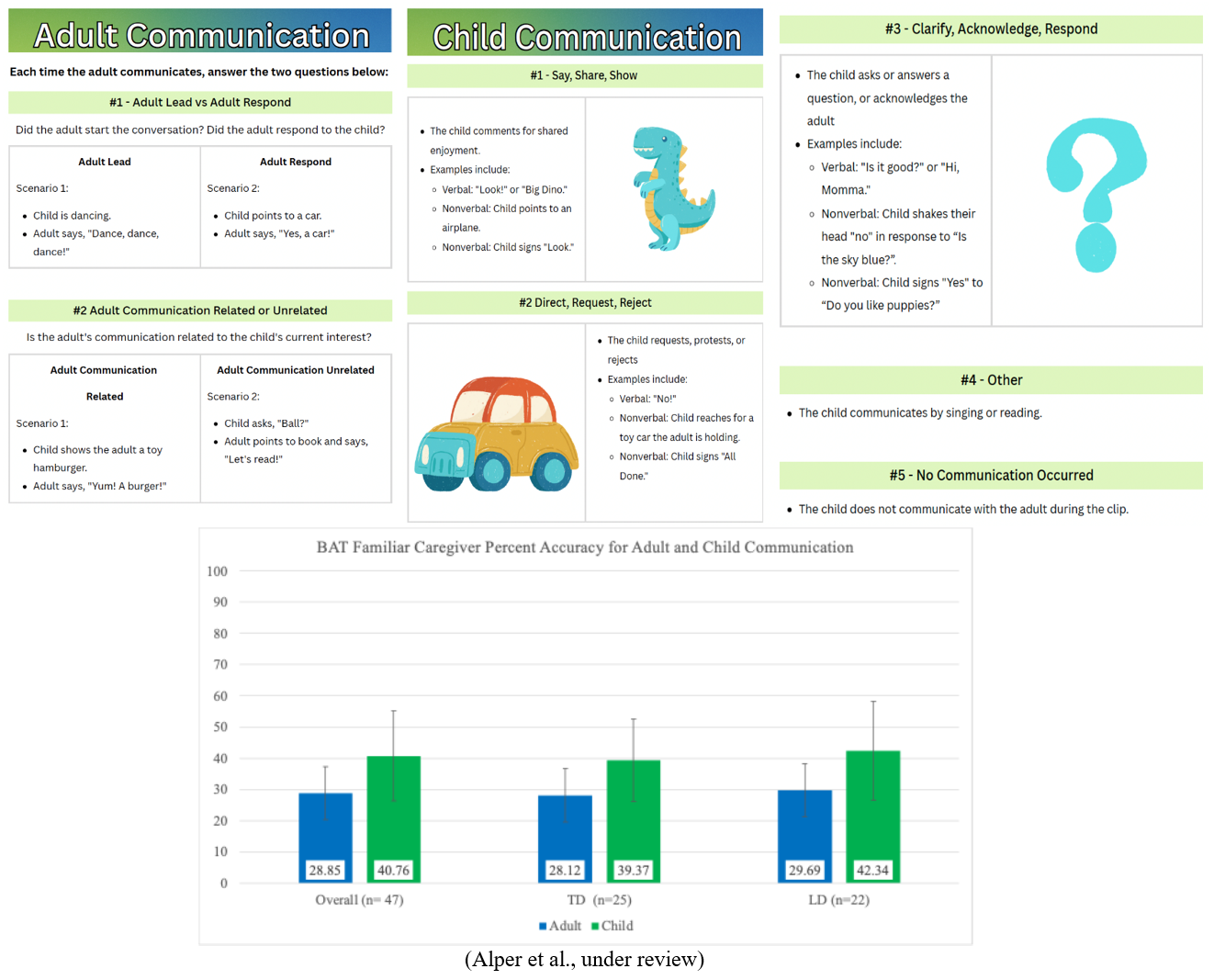
Title: The Behavioral Awareness Task: Quantifying caregivers’ awareness of adult and child communication during early interaction
Citation: Alper, R.M., Grindle, E., Jumbeck, L., & Schiltz, J. (under review). The Behavioral Awareness Task: Development and preliminary data on caregivers’ perceptions of adult and child communicative acts.
Purpose: Children with language delays are at risk for persistent disorder as well as lower long-term outcomes. Caregiver coaching is an evidence-based component of early intervention. Coaching often aims to support caregivers in providing their children with additional, individually scaffolded language input. The type of language input caregivers are coached to provide is often linguistically simple implementing, but caregivers vary in their baseline skills and readiness. The purpose of this study was to quantify caregiver strengths and needs in identifying adult and child communication attempts.
Methods: This was a cross-sectional, observational, analysis of baseline data from a behavioral clinical trial. Participants in this study included n = 25 caregivers and children with delayed language skills (LD group) 2;6-4;0 and n = 25 caregivers and children with typical language skills 1;4-1;8 matched on expressive language.
Results: Across conditions we observed limited floor and ceiling effects, with substantial individual variability for caregivers of children with typical and delayed language skills. Across groups, performance in the unfamiliar condition was higher than in the familiar. We found one significant interaction such that caregivers in the LD group were more likely to underestimate the number of times their own children communicated, while those in the TD group tended to overestimate. Additionally, we found that performance on elements of the BAT was associated with other caregiver skills linked to interaction quality.
Conclusions: Identifying and categorizing adult and child communication is a foundational skill for implementing language-stimulation strategies. This was the first study to quantify caregivers’ baseline skills in this area during video analysis. Performance was varied, which highlights the opportunity for individualized caregiver support. These findings will drive future research exploring the association between BAT performance, interaction quality, and implementation of early language intervention strategies.

Investigator: Rebecca Alper, PhD
About the Lab: Research in the Language, Literacy, and Learning Lab focuses on improving the language, academic, and health outcomes of at-risk children through family-centered early language and literacy intervention.