
Randolph Ashton, PhD – Slide of the Week
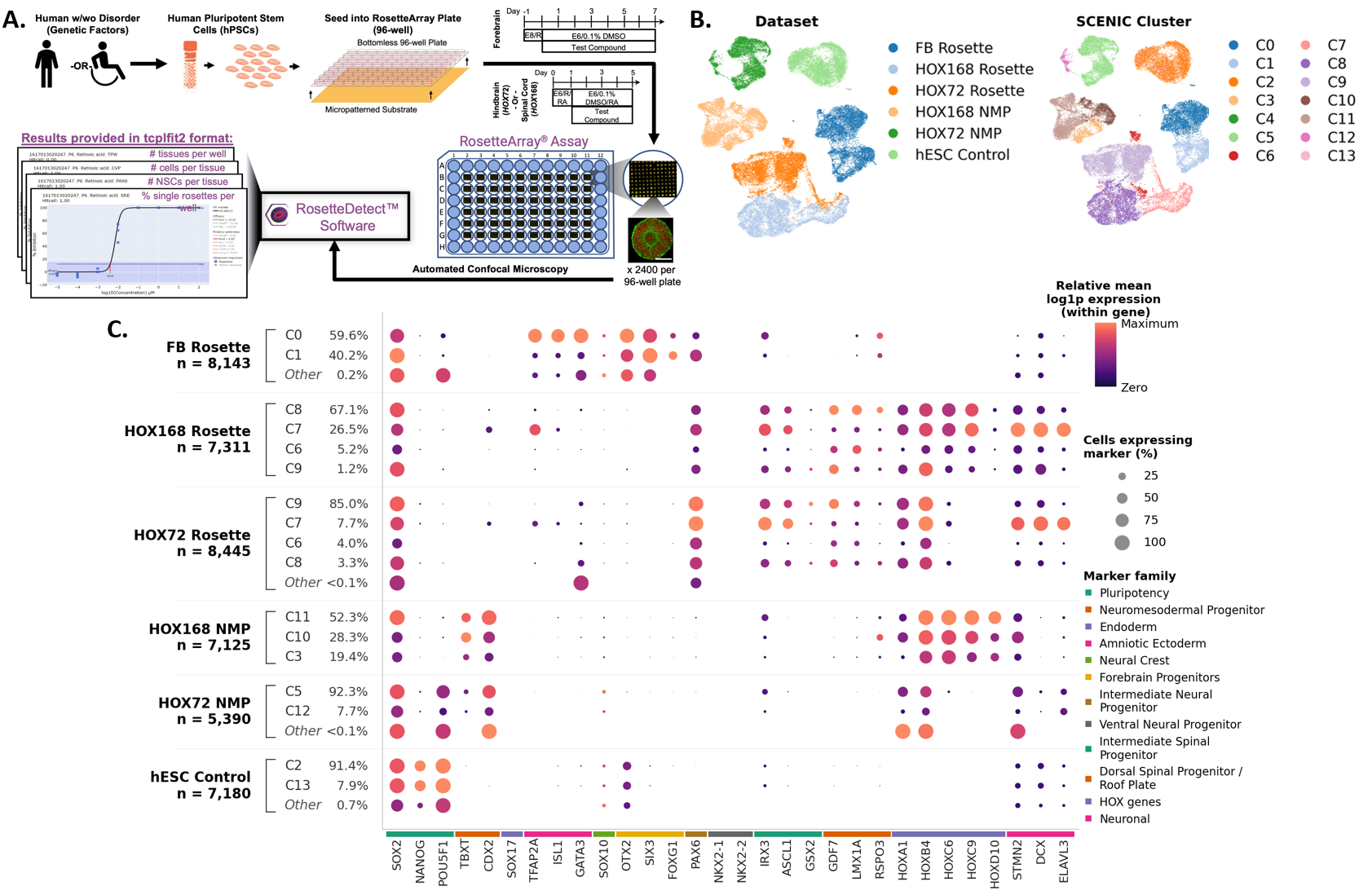
Title: Analysis of Forebrain, Hindbrain, and Lumbar Spinal RosetteArray Tissues using Sc-RNA sequencing.
Legend: (A) Schematic of the RosetteArray screening pipeline with (B) UMAP of the Assay’s seeded and derived cell populations with SCENIC regulon-activity algorithm clustering. (C) Dot plot visualization of gene expression across SCENIC regulon clusters grouped by experimental cell populations.
Related Citation: Brady F. Lundin, Gavin T. Knight, Nikolai J. Fedorchak, Kevin Krucki, Frank Siepel, Nisha Iyer, Jack E. Maher, Nicholas R. Izban, Abilene Roberts, Madeline R. Cicero, Joshua F. Robinson, Bermans J. Iskandar, Rebecca Willett, Randolph S. Ashton. bioRxiv 2024.04.01.587605; doi: https://doi.org/10.1101/2024.04.01.587605
Summary: Neural organoids have revolutionized how human neurodevelopmental disorders (NDDs) are studied. Yet, their utility for screening chemical hazards and prospective therapeutics for NDDs
is limited by a lack of morphological reproducibility and cost-effective scalability. Here, we
describe the RosetteArray platform, which can be used as an off-the-shelf, 96-well plate assay
that standardizes incipient forebrain and spinal cord organoid morphogenesis as adherent,
micropatterned, 3-D, singularly polarized neural rosette tissues (~200 and ~800 per well,
respectively). Seeded directly from cryopreserved human pluripotent stem cells, RosetteArrays
are cultured over 6-8 days and fixed, immunostained and imaged in situ to enable artificial
intelligence-based quantitative analysis. By screening the inception of ~75,000 neural organoids
throughout this manuscript, we provide proof-of-concept demonstrations of the platform’s utility
for detecting developmental neurotoxicity hazard and screening genetic and environmental
factors known to cause clinical Neural Tube Defect risk. Given the documented perturbation of
rosette morphogenesis in neural organoid models of several NDDs, the RosetteArray platform
could enable quantitative high-throughput screening (qHTS) of human neurodevelopmental risk
across regulatory and precision medicine applications.
About the Lab: The goal of the Ashton Lab is to understand, model, and recapitulate in vitro the instructive signals utilized by human embryos to pattern tissue-specific differentiation of pluripotent stem cells, and apply this knowledge towards the rational design of tissue engineered scaffolds and other regenerative therapeutic strategies. Currently, the lab is primarily focusing on generating tissues and therapies for the central nervous system.
Investigator: Randolph Ashton, PhD