
Anita Bhattacharyya, PhD – Slide of the Week
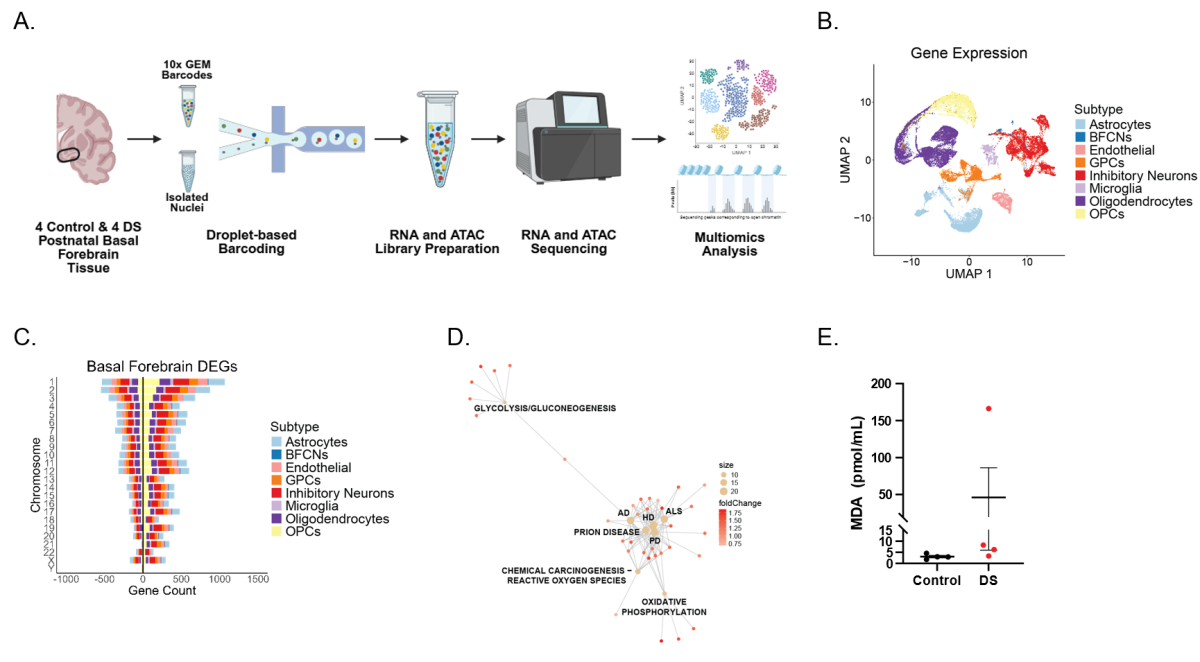
Title: Single-nucleus analysis reveals oxidative stress in Down syndrome basal forebrain neurons at birth
Legend: A) Single-nucleus multiomic analysis of human basal forebrain samples from four control and four Down syndrome (DS) donors. B) Cell subtypes identified in the human basal forebrain were astrocytes, basal forebrain cholinergic neurons (BFCNs), endothelial cells, glial progenitor cells (GPCs), inhibitory neurons, microglia, oligodendrocytes, and oligodendrocyte precursor cells (OPCs). C) Counts of differentially expressed genes (DEGs) in cell types of the DS basal forebrain. DEGs are distributed across the genome in all cell types. Upregulated genes are represented by positive values, while downregulated genes are represented by negative values. D) Dysregulated genes in DS BFCNs encode proteins in the oxidative phosphorylation and glycolysis/gluconeogenesis pathways as well as antioxidant enzymes that detoxify reactive oxygen species (ROS) byproducts generated from oxidative phosphorylation. These dysregulated genes are associated with several neurodegenerative diseases, including Alzheimer’s disease (AD), Parkinson’s disease (PD), Huntington’s disease (HD), prion disease, and amyotrophic lateral sclerosis (ALS). E) Lipid peroxidation, a downstream consequence of ROS, is increased in the DS basal forebrain suggesting there is metabolic dysregulation and accumulation of ROS at birth in the DS basal forebrain.
Citation: West, N. R., Arachchilage, K. H., Knaack, S., MacGregor, S., Hosseini, M., Risgaard, R. D., Kumarage, P., Martinez, J. L., Zhang, S. C., Wang, D., Sousa, A. M. M., & Bhattacharyya, A. (2025). Single-nucleus analysis reveals oxidative stress in Down syndrome basal forebrain neurons at birth. Alzheimer’s & dementia : the journal of the Alzheimer’s Association, 21(7), e70445. https://doi.org/10.1002/alz.70445
Abstract:
Introduction – Basal forebrain cholinergic neurons (BFCNs) are integral to learning, attention, and memory, and are prone to degeneration in Down syndrome (DS), Alzheimer’s disease, and other neurodegenerative diseases. However, the mechanisms that lead to the degeneration of these neurons are not known.
Methods – Single-nucleus gene expression and Assay for Transposase-Accessible Chromatin (ATAC) sequencing were performed on postmortem human basal forebrain from unaffected control and DS tissue samples at 0-2 years of age (n = 4 each).
Results – Sequencing analysis of postmortem human basal forebrain identifies gene expression differences in DS early in life. Genes encoding proteins associated with energy metabolism pathways, specifically oxidative phosphorylation and glycolysis, and genes encoding antioxidant enzymes are upregulated in DS BFCNs.
Discussion: Multiomic analyses reveal that energy metabolism may be disrupted in DS BFCNs by birth. Increased oxidative phosphorylation and the accumulation of reactive oxygen species byproducts may be early contributors to DS BFCN neurodegeneration.
Highlights – First multiomic gene expression and ATAC analysis of human basal forebrain. Basal forebrain pathology in DS begins by birth. Cell type proportions are altered in early postnatal DS basal forebrain. Gene expression suggests dysregulated energy metabolism in DS BFCNs. Genes encoding oxidative phosphorylation subunits and glycolysis enzymes are dysregulated in DS BFCNs.
Keywords: Down syndrome; basal forebrain cholinergic neurons (BFCNs); glycolysis; oxidative phosphorylation (OXPHOS); reactive oxygen species (ROS); snMultiomic analysis.
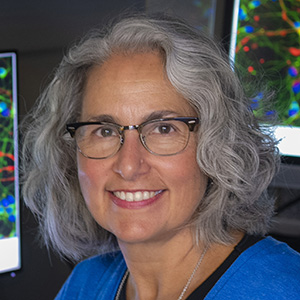
Investigator: Anita Bhattacharyya, PhD
About the Lab: Anita Bhattacharyya’s lab examines how brain development is altered in developmental disorders characterized by intellectual impairment. The cerebral cortex is the most complex area of the brain and is responsible for functions unique to humans, such as language and abstract thought. Problems in any of the crucial cerebral cortex formation steps can lead to intellectual impairment.