
Margarita Kaushanskaya, PhD – Slide of the Week
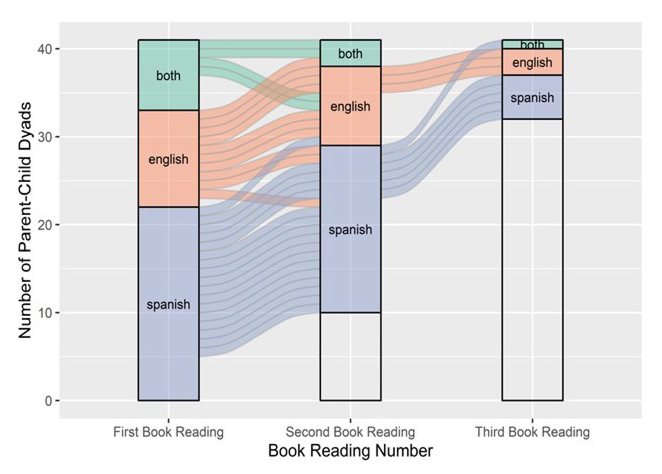
Title: Persistence of Parental Language Use when Reading Bilingual Books to Children
Legend: Flow diagram depicting the number of books read in Spanish, English, or both languages across three book reading opportunities, represented by three bars. Individual lines connecting the bars represent parent-child dyads and what language they used for each book. The majority of books were read in Spanish only, and very a few parents used both languages when reading bilingual books.
Citation: Slawny, C. M., Knabe, M. L., & Kaushanskaya, M. (2026). How are bilingual storybooks read? Parents’ language choice during shared book reading. International Journal of Bilingual Education and Bilingualism, 29(1), 85-103.
Abstract: Bilingual storybooks are designed to be read in two languages and might be a promising way to support emerging language skills of bilingual children (Castro et al. 2011. ‘Promoting Language and Literacy in Young Dual Language Learners: Research, Practice, and Policy.’ Child Development Perspectives 5 (1): 15-21). However, limited research has investigated how bilingual parents use bilingual storybooks during shared reading: Do they use both languages or read in a single language? Do parent language profiles predict language choice? The current study addresses this gap by analyzing recordings of 41 Spanish-English bilingual parent-child dyads reading bilingual storybooks. Most parents read their first book in one language (80.5%) and only 31.7% of parents switched their language choice between books. Pairwise comparisons between parents who used a single language vs. both languages revealed that parents who read in both languages had higher socioeconomic status, were more English dominant, and had higher English reading proficiency, as compared to parents who read in just Spanish. Furthermore, bilingual parents’ language choice was predicted by their own and their children’s language dominance. This work suggests that parents’ language choices during storybook reading depend on the family’s language characteristics, rather than on the availability of text in two languages, highlighting the complex nature of bilingual storybook practices in the home.
Investigator: Margarita Kaushanskaya, PhD
About the Lab: Margarita Kaushanskaya is a professor in the Department of Communication Sciences and Disorders. Research in her Language Acquisition and Bilingualism Lab (LAB) examines language and cognitive development in bilingual children with and without developmental disabilities.