
Caroline A Niziolek, PhD – Slide of the Week
Title: Sensorimotor adaptation to a nonuniform formant perturbation is preserved in healthy aging
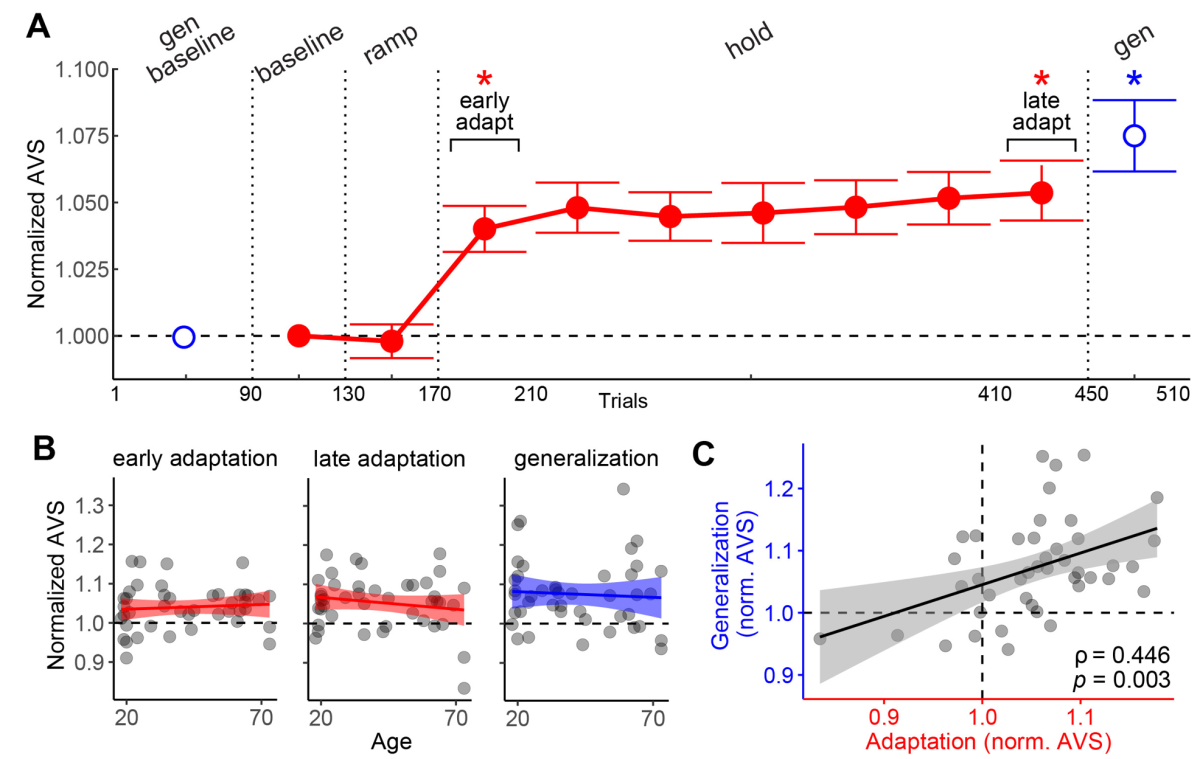
Legend: (A) Participants exposed to a “vowel centralizing” perturbation to their auditory feedback adapt by increasing their produced vowel spacing (AVS). (B) Participants adapt similarly across the adult lifespan (no effect of age). (C) Adaptation is correlated with generalization to untrained vowels.
Citation: Cheng, H. S., Niziolek, C. A., & Parrell, B. (2026). Sensorimotor Adaptation to a Nonuniform Formant Perturbation Is Preserved in Healthy Aging. Journal of speech, language, and hearing research : JSLHR, 69(3), 920–931. https://doi.org/10.1044/2025_JSLHR-25-00503
Abstract:
Purpose – Young adult speakers can be induced to increase the acoustic contrast between vowels through exposure to a nonuniform auditory “centralization” feedback perturbation that makes vowels sound less distinct from one another. While this result suggests that sensorimotor adaptation is a promising learning mechanism to drive behaviorally relevant changes related to speech intelligibility, existing res sensorimotor adaptation in speech has largely focused on younger adults. Given established age-related deficits in speech motor performance, it is possible that healthy aging itself negatively impacts speech motor learning; however, these potential effects of age are currently unknown. Here, we examine the effects of healthy aging on the magnitude of both adaptation to the complex “centralization” paradigm as well as the generalization of this learning to untrained vowels.
Method – Forty-three neurobiologically healthy speakers (age range: 18-73 years) read monosyllabic words with corner vowels, while their auditory feedback was shifted toward the center of the vowel space. Adaptation was measured as the increase in vowel contrast induced by this perturbation. Generalization was tested in monosyllabic words with noncorner vowels produced under masking noise.
Results – Speakers adapted to the perturbation, producing the trained corner vowels farther from the vowel center, with increased acoustic contrast among them. This learning generalized robustly to untrained noncorner vowels. Crucially, age did not affect the magnitude of adaptation nor the magnitude of the generalization.
Conclusion – These findings demonstrate that healthy aging does not impair sensorimotor adaptation in speech, further establishing that sensorimotor adaptation can be leveraged to drive behaviorally relevant changes in speech in older adults with acquired motor speech disorders.

Investigator: Caroline A Niziolek, PhD
About the Lab: The Niziolek lab studies how the feedback system functions in persons with aphasia, many of whom have deficits in speech production and error awareness. They are developing laboratory studies of speech skill learning that can be translated to training interventions for speakers such as these who have trouble consistently producing auditory targets. The lab’s proposed training consists of vocal games that map speech to a real-time visual display. These visual speech training games have the potential to be adapted into tools to improve speech production in individuals with speech impairment, including deaf speakers and children with developmental speech and language disorders.