
Bobby Gibbs, PhD – Slide of the Week
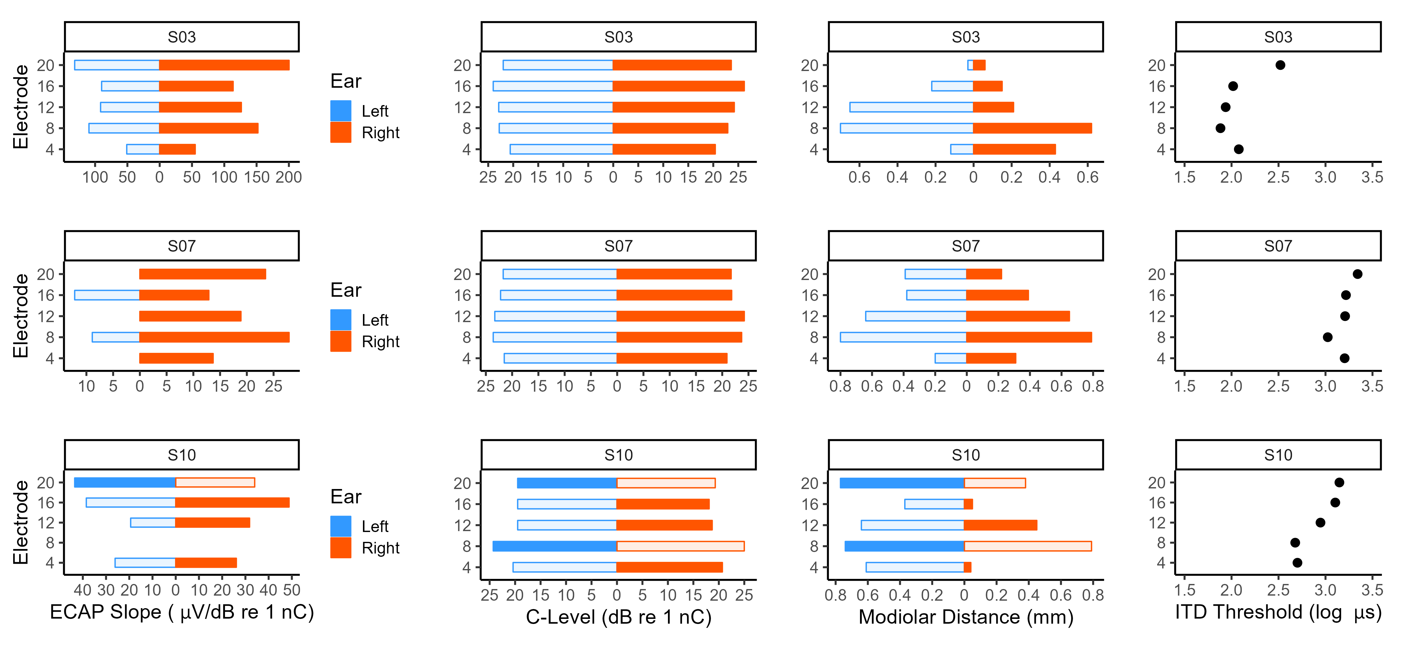
Title: Example of non-uniformity in monaural measurements across the ears and ITD thresholds across electrodes for three participants
Legend: Examples of how the better electrode (BE), assumed to provide the best neural stimulation (typically the ear with the steeper ECAP slope), was not always consistent across the electrode array. An example is participant S10 for whom the BE (filled bars) was the right ear (orange) for electrodes 4, 12, and 16 and the left ear (blue) for electrodes 8 and 20. ECAP slope was sometimes unavailable in both ears (e.g., S10 electrode 8) in which case the BE was defined by the lowest C-level of the number-matched pair. C-level = Current level associated with most comfortable loudness level. ECAP= Electrically Evoked Compound Action Potential. ITD= Interaural Time Difference.
Citation: Gibbs, B., Cleary, M., Bernstein, J, & Goupell, M. (in press). Predicting interaural time difference sensitivity for bilateral cochlear-implant listeners from loudness levels and factors reflective of the electrode-to-neural interface. Trends in Hearing.
Abstract: This study evaluated how interaural-time-difference (ITD) thresholds for bilateral cochlear-implant listeners were related to monaural and binaural factors associated with behavioral loudness perception and objective measures associated with the interface between electrode contacts and target neurons (the electrode-to-neural interface, ENI). For 11 bilateral cochlear implant listeners, ITD thresholds for number-matched interaural electrode pairs were measured at five places along the array. On these same electrodes, the most comfortable current level used for stimulation (C-level), electrically evoked compound action potentials (ECAPs), and electrode positions relative to the modiolus based on computed-tomography scans were recorded. Monaural predictors included stimulation level (quantified by C-levels), modiolar distance (related to the width of neural activation), and efficacy of auditory nerve fiber responses to electrical stimulation [ECAP amplitude growth function (AGF) slopes]. Binaural predictors included the degree of interaural asymmetry in both C-levels and modiolar distances. It was hypothesized that better ITD sensitivity would be related to higher C-levels and larger modiolar distances (because of increased loudness and broader neural activation), steeper ECAP AGF slopes (because of more numerous and healthy neurons), and smaller interaural asymmetry (because of a larger proportion of binaurally excited neurons). The hypotheses were tested via backwards elimination in mixed-effects models with bias and stability analyses performed using bootstrapping. Partially confirming the hypotheses, higher C-levels and greater modiolar distance for electrodes in the ear with better ENI (as defined primarily by the ECAP AGF slope) were significantly associated with better ITD thresholds. These results highlight the role of monaural processing in binaural performance.

Investigator: Bobby Gibbs, PhD
About the Lab: Bobby Gibbs, PhD is director of the Auditory Encoding and Processing Optimization (AEPO) Lab