
Austin Pier & Ngawang Namru (Gomez Laboratory) – Slide of the Week
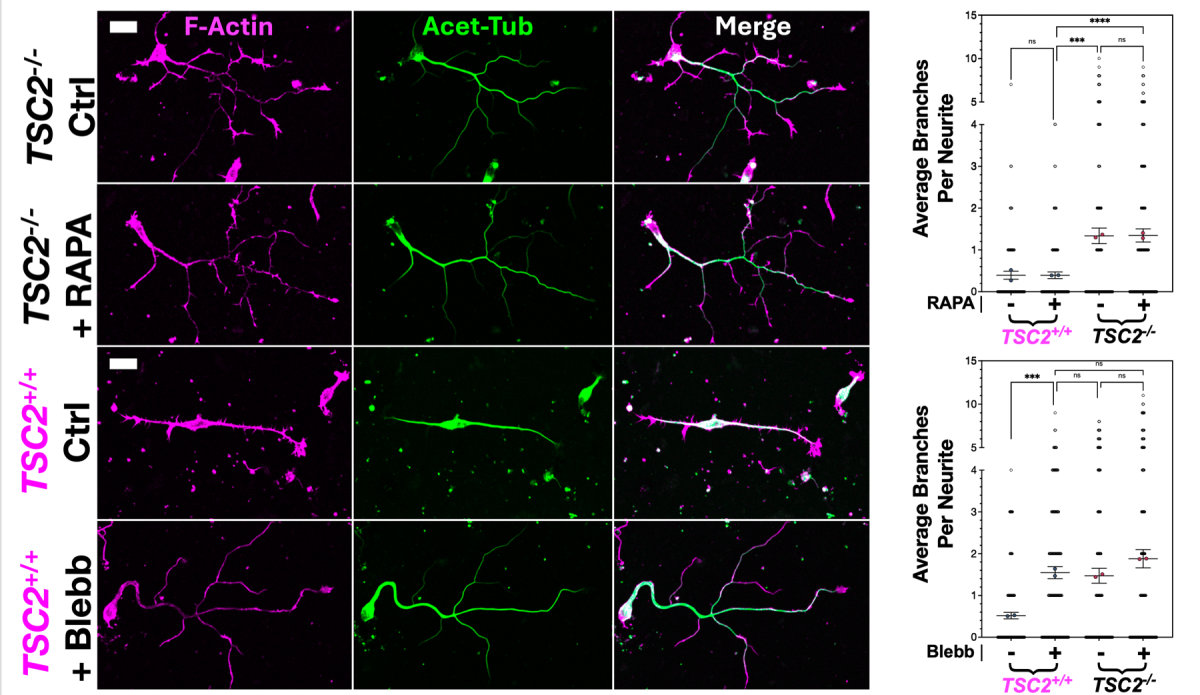
Title: Increased branching TSC2-/- neurons is dependent on RhoA signaling, but independent of mTOR signaling
Legend: Dissociated cultures of TSC2+/+ and TSC2-/- human forebrain neurons were treated with Blebbistatin (a Myosin II inhibitor) or Rapamycin (an mTOR inhibitor) for 24 hours. Neurons were fixed and stained with phalloidin to label F-Actin (Magenta) and an antibody to label Acetylated-Tubulin (Green) for visualization of neurite branching. Note that Rapamycin treatment of both TSC2+/+ and TSC2-/- neurons has no effect on neurite branching when compared to untreated controls of each genotype. However, Blebbistatin treatment of TSC2+/+ neurons phenocopies increased neurite branching observed in TSC2-/- control neurons. These results suggest increased neurite branching in TSC2-/- neurons is dependent on changes in RhoA signaling, and independent of mTOR signaling. Imaging and analysis performed by Austin Pier and Ngawang Namru, Gomez Laboratory.
Citation: Unpublished, Austin Pier and Ngawang Namru (Gomez Laboratory)
Abstract: Tuberous Sclerosis Complex (TSC) is an autosomal dominant neurodevelopmental disorder caused by a monogenic mutation to either TSC1 or TSC2. Nearly one-half of TSC patients have mild to profound intellectual disabilities and autism, with the majority developing seizures and neuropsychiatric conditions. The TSC1 and TSC2 proteins are known to interact and form a protein complex (TSC1-TSC2), which negatively regulates mTORC1-mediated protein synthesis and activates mTORC2-mediated cytoskeletal rearrangements. Regulation of local protein synthesis and the cytoskeleton are vital for proper development, axon guidance, and neural network formation. Interestingly, previous work in our lab found that human forebrain neurons differentiated from TSC2+/- induced pluripotent stem cells (iPSCs) exhibited dramatic defects in axon outgrowth and sensitivity toward several canonical axon guidance cues. Surprisingly, these defects were found to be independent of both mTORC pathways, while basal and cue-activated RhoA signaling was diminished.
Investigator:
About the Lab: Current work in the lab is focused on characterizing new, RhoA-dependent and known, mTOR-dependent phenotypes in TSC2-/- neurons. These phenotypes will be useful for conducting rescue experiments using multiple lentiviruses (LVs) which are engineered to express Tet-inducible, Halo-tagged full-length TSC2 or Halo-tagged TSC2 domain mutants. These LVs allow us to acutely restore the normal expression levels of TSC2 in TSC2+/- and TSC2-/- iPSCs and neurons. We have confirmed the efficacy of our full-length Halo-TSC2 construct by demonstrating its ability and to reduce elevated mTOR signaling in TSC2-/- iPSCs and neurons. This work is aimed at determining which domains of TSC2 are important for RhoA signaling and if these domains are different from those required for TSC2’s role in regulating mTOR signaling (e.g. TSC2’s GAP domain). This figure illustrates one of our new phenotypes, dramatically increased branching observed in TSC2-/- neurons, which is dependent on RhoA signaling and independent of mTOR signaling.