
Tracy L. Hagemann, PhD – Slide of the Week
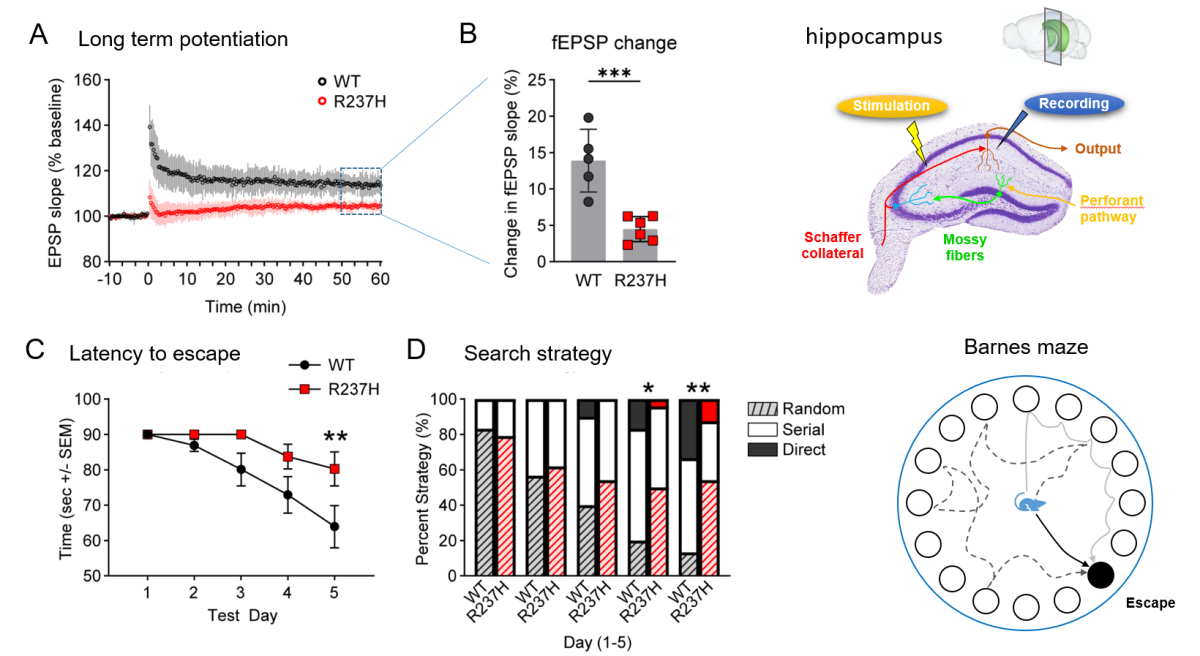
Title: Deficits in synaptic plasticity and learning in a Gfap+/R237H rat model of Alexander disease
Legend: Deficits in hippocampal long-term potentiation and spatial learning in the Gfap+/R237H rat model of Alexander disease. (A) Mean field excitatory postsynaptic potential (fEPSP) slope for wild type (WT) and Alexander model rats (R237H) before and after a theta-burst stimulation (TBS) paradigm with three trains of 10 bursts (4x100Hz). (B) Comparison of potentiation, defined as the average mean fEPSP slope during the last 10 minutes compared to baseline, demonstrates reduced synaptic plasticity in R237H rats. (***p = 0.0008 t-test, N = 5 WT, and 6 R237H rats. Error bars = standard deviation). (C) Latency to escape and (D) search strategy patterns (random, serial, direct) used by WT and R237H rats to learn the location of the escape hole in the Barnes maze over 5 training days demonstrate impaired spatial learning in R237H rats (p = 0.018 for effect of genotype, mixed-effects model, **p < 0.01, Sidak’s post-test, error bars = SEM in C; Chi Square, *p<0.05 and **p<0.01, N = 30 WT, 24 R237H in D).
Citation: Berman, R. F., Matson, M. R., Bachman, A. M., Lin, N. H., Coyne, S., Frelka, A., Pearce, R. A., Messing, A., & Hagemann, T. L. (2025). GFAP mutation and astrocyte dysfunction lead to a neurodegenerative profile with impaired synaptic plasticity and cognitive deficits in a rat model of Alexander disease. eNeuro, 12(3), ENEURO.0504-24.2025. Advance online publication. https://doi.org/10.1523/ENEURO.0504-24.2025
Abstract: Alexander disease (AxD) is a rare neurological disorder caused by dominant gain-of-function mutations in the gene for glial acidic fibrillary protein (GFAP). Expression of mutant protein results in astrocyte dysfunction that ultimately leads to developmental delay, failure to thrive, and intellectual and motor impairment. The disease is typically fatal, and at present there are no preventative or effective treatments. To gain a better understanding of the link between astrocyte dysfunction and behavioral deficits in AxD we recently developed a rat model that recapitulates many of the clinical features of the disease, including failure to thrive, motor impairment, and white matter deficits. In the present study, we show that both male and female AxD model rats exhibit a neurodegenerative profile with a progressive neuroinflammatory response combined with reduced expression of synaptic and mitochondrial proteins. Consistent with these results AxD rats show reduced hippocampal long-term potentiation and are cognitively impaired, as demonstrated by poor performance in the Barnes maze and novel object recognition tests. The AxD rat provides a novel model in which to investigate the impact of astrocyte pathology on central nervous system function and provides an essential platform for further development of effective treatments for AxD and potentially other neurodegenerative diseases with astrocyte pathology.Significance Statement Alexander disease (AxD) is a fatal neurodegenerative disorder caused by gain-of-function GFAP mutations. We recently developed a Gfap +/R237H rat model which demonstrates hallmark astrocyte pathology, myelin deficits, and motor impairment. Here, we show that Gfap +/R237H rats also exhibit reduced synaptic plasticity and cognitive deficits as additional clinically relevant phenotypes, further demonstrating its utility as a model. Hippocampal transcriptomic analysis in young adult animals reveals a neurodegenerative signature with an innate immune response and loss of synaptic and metabolic gene expression, features that are typically associated with chronic diseases of aging. These results reveal mechanisms by which astrocyte dysfunction leads to learning and memory deficits in AxD and perhaps contributes to other diseases such as Alzheimer’s and Parkinson’s.

Investigator: Tracy L. Hagemann, PhD
About the Lab: The Alexander Disease Research Lab focuses on the role of astrocytes in neurodegenerative disease and the cellular consequences of their dysfunction. Astrocytes have traditionally been thought of as support cells that maintain ion and neurotransmitter homeostasis in the central nervous system (CNS). However, research over the past few decades has revealed more complex functions including the regulation of neurogenesis, synaptogenesis, neurotransmission and remyelination. In addition, astrocytes control blood flow, maintain the blood brain barrier, and contribute to the distribution and clearance of compounds through the CNS glymphatic system.