
How LEND training shaped a Waisman CASC clinician’s approach to inclusive care and communication access
By Emily Leclerc | Waisman Science Writer
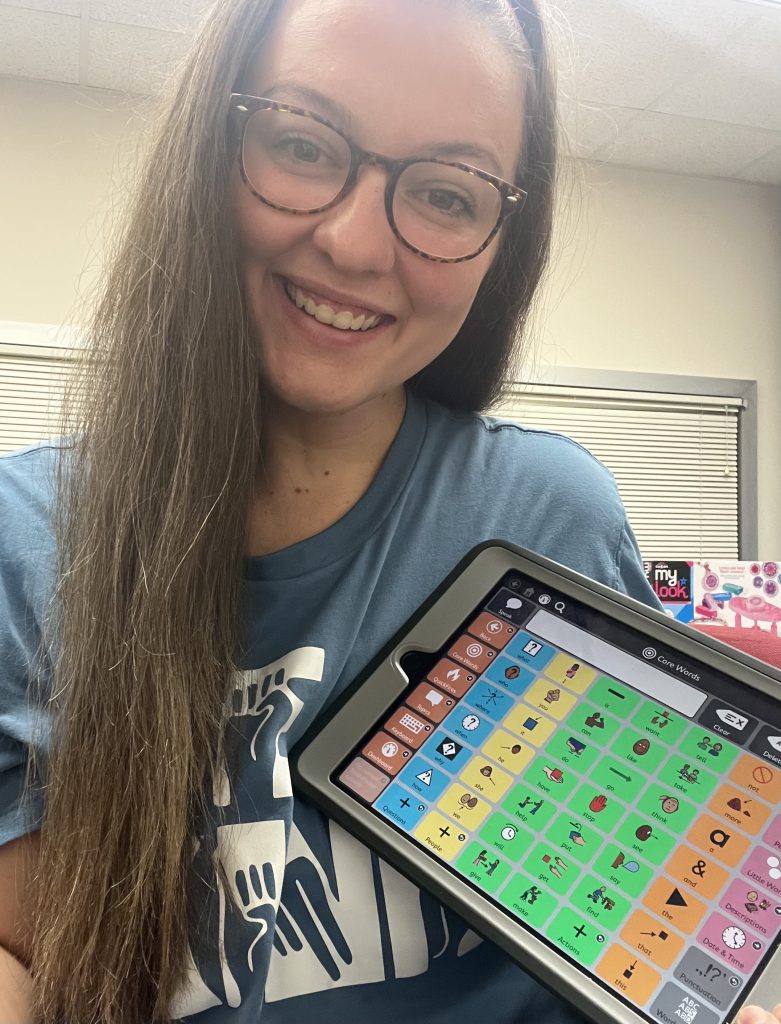
Communication is fundamental for participating in society. Without it, people struggle greatly to get their needs met, interact with others, and be a part of the world around them. Rebecca (Becca) Stroschein, MS, CCC-SLP, speech language pathologist in Waisman’s Communication Aids and Systems Clinic (CASC), realized while volunteering as an undergraduate student at a non-profit for autistic adults, that she held a deep passion for helping others find a form of communication that works for them so that they can have access to their community.
After completing her graduate studies in speech therapy, Stroschein then had to find a nine-to 12-month fellowship program as the final part of her training. She had two things in particular she was looking for in a fellowship. The first was a focus in augmentative and alternative communication (AAC) work. “That’s a big part of what drew me to this fellowship at the Waisman Center. It is such a specialized program that my entire caseload is all communication device work,” Stroschein says. The second was a LEND program.
A Leadership Education in Neurodevelopmental and Related Disabilities (LEND) program is a special training program funded by the federal Maternal & Child Health Bureau of the Department of Health & Human Services. The WI LEND training program, which is part of the Waisman Center’s UCEDD (University Center for Excellence in Developmental Disabilities), prepares leaders to improve services and supports for children with or at risk for neurodevelopmental diseases by training healthcare professionals, self-advocates, and family members. The WI LEND program is an integrated part of the CASC clinical fellowship. “LEND being a part of this fellowship is the other big reason why I chose to apply,” Stroschein says. “I knew that it would help me become a better speech therapist.”
Stroschein recently graduated from WI LEND and became a full-time clinician in CASC after completing a clinical fellowship in the clinic. She says that there is a considerable amount she is taking away from the program and many of the lessons will serve her well throughout the rest of her career. “The knowledge from LEND, letting me see so much of what families with kids with disabilities go through, and learning from those with lived experiences will equip me well in my future,” Stroschein says.
Some of her most impactful takeaways revolve around being an effective member of an interdisciplinary team and developing the skills to help educate others on how they can support the disability community.
Interdisciplinary care is a core tenet of the Waisman Center’s clinics. The collaboration between different experts helps create more comprehensive and patient-focused care and allows for a more well-rounded understanding of the patient. When she was a clinical fellow, Stroschein was already working on an interdisciplinary team, both in CASC as a whole and she spent two days out of the week co-treating patients with an occupational therapist. She says that her participation in LEND developed that skill even more.
“LEND truly prepares you to go out into the world and be a strong contributor on any interdisciplinary team,” Stroschein says. “Knowing how to use my voice on a team and being able to provide accessibility and inclusive services is so important.”
One of Stroschein’s big goals is to help push the field of AAC further by building capacity and educating others to increase understanding and awareness. AAC – the use of devices or tools to help replace or augment spoken language – is still relatively unknown to the general populous. This means that there are likely people who could benefit from using AAC that are unaware of its existence. Her LEND training has provided her with the tools and skills needed to not only work with policy makers and professionals to expand access but also help educate the larger general public.
“I think the more we can enable other professionals, teams, and families to feel confident in their abilities to use communication devices and recommend communication systems, the more our field and the individuals we serve will benefit in the long run,” Stroschein says.
A major component of LEND training is learning from those with lived experience, either an individual with a disability or family members of individuals with disabilities. Who better to learn from than someone who experiences a disability every day. “The times where I got to go with a family to different activities around the community or just hear their stories helped me see what life is like from whole new perspectives,” Stroschein says. “The lives of people with disabilities and their families are so robust and we, as clinicians, need to be able to support so many aspects of their lives and encourage them to participate in some of the incredible things that are out there.”
Stroschein adores her job and couldn’t see herself doing anything else. LEND provided her with knowledge and insights that she may not have gotten otherwise. She says that she is a better speech therapist having been a part of LEND.
“It really is something magical when you are working with someone who doesn’t have a means to communicate and suddenly, when you find the right fit, they are able to say all of the things they have been wanting to,” Stroschein says. “Helping individuals find a reliable way to meaningfully communicate with the world around them is honestly one of the best parts of my job. And I will carry LEND’s lessons with me for the rest of my career.”