
Typing, tapping, and eye-gaze tracking: Augmentative and alternative communication provides crucial access to communication when speech is out of reach
By Emily Leclerc | Waisman Science Writer
At a Glance:
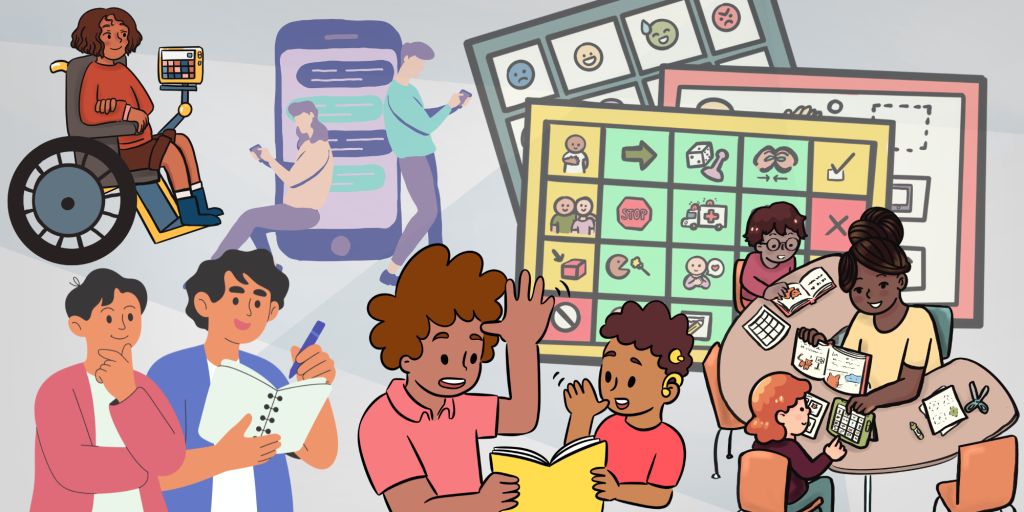
- Augmentative and alternative communication (AAC) is any method of communication that isn’t spoken language, such as texting, writing on paper, picture and letter boards, tablet, or an eye-gaze tracker. It can be used long-term or short-term and is not always a replacement of speech but is also often in addition to speech.
- AAC is highly customizable and can look different for every person. Many AAC devices are accessible to individuals without needing to see a clinician or specialty clinic.
- The Waisman Center’s Communication Aids and Systems Clinic (CASC) works with individuals with disabilities and significant communication difficulties to fit them with an AAC device that suits their needs and abilities.
- CASC is unique in that it employs an AAC focused occupational therapist whose job it is to figure out the best way for someone to access their device.
- Communication is a fundamental right. AAC can give people access to that communication allowing people to lead autonomous and independent lives where they have agency over themselves and their choices.
- For many parents of children with communication difficulties, hearing their child communicate with an AAC device for the first time is as impactful as hearing a child speak their first word. “As a parent, them getting a device and using it is no different than hearing your kids speak for the first time. I cried so hard with Corbin the first time he pushed that button. It was like him talking to me for the first time,” Raschka says. “It is invaluable.”
For many, talking is as easy as breathing. A few words to tell your friend that you are hungry and ready for lunch. A long rant to your partner about frustrations at work. A description of what hurts to your doctor. A quiet, ‘I love you,’ to a close family member. Being able to talk helps to make communicating efficient and effective. But not everyone has access to speech.
For someone who struggles to speak, can only speak some of the time, or cannot speak at all, effective communication can be challenging. Needs can go unmet, wants unknown, and thoughts trapped inside someone’s head. Communication is the avenue through which people participate in everything – society, community, relationships, family, and more. It gives someone agency over their life, body, and choices. Being cut off from that, due to a lack of access to speech, can have monumental consequences.
“Communication is a fundamental right,” says Jenn Seale, PhD, CCC-SLP, AAC program director and director of the Waisman Center’s Communication Aids and Systems Clinic (CASC). “It’s the means by which we affect everything in our lives. Without it, people don’t have a choice, the ability to be autonomous or independent, or have a self-directed life.”
Everyone needs and deserves access to an effective form of communication that works for them.
Augmentative and alternative communication (AAC) is any method of communication that isn’t spoken language. It can encompass multiple methods of expression, such as pointing, texting, writing on paper, picture or letter boards, tablets, and eye-gaze trackers. People often use multiple forms of AAC at one time and some even use it to augment their speech as needed. American Sign Language is considered to be AAC. It can be do-it-yourself projects or tools specifically designed to be AAC.
Regardless of the form it takes, having access to communication is everything. “Two of my kids live in this world where they can’t tell us what they need with their words. So, they just sit in this place where they feel like they can’t get their needs met. That has got to be almost like hell,” Jessica Raschka says. Raschka and her husband have a total of six kids. The two youngest, Corbin (who is eight) and Jaxson (who is five), both have Down syndrome and are both nonverbal. Down syndrome is a genetic condition caused by a third extra copy of the 21st chromosome and is the most common genetic cause of intellectual and developmental disability.
Raschka could see that her boys were trying to communicate with her and others through nonverbal ways, could see them struggling to make themselves understood. Both Corbin and Jaxson see Maria Stanley, MD, developmental behavioral pediatrician in three Waisman Center clinics including the Down Syndrome Clinic. Stanley quickly saw that Corbin and Jaxson could benefit greatly from AAC.
“AAC is an opportunity to open up the world to someone in a way they didn’t have before,” says Theresa Cassel, MOTR/S, ATP, occupational therapist in CASC. “We want people to understand us and we want to be able to interact with others. We are social creatures. Without access to communication, we end up isolated.”
Behavior can be communication too
On a fundamental level, communication is critical for getting needs and wants met, for being able to tell someone that you are hungry, thirsty, hurting, or need help. If someone can’t vocalize those needs or have them understood, that often leads to frustration and the use of behavior as a means of communication.
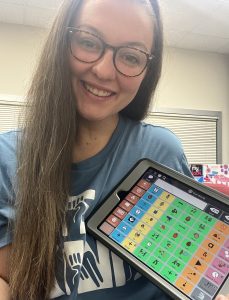
“If you were talking to someone and they couldn’t understand what you were saying even though you kept saying it over and over again, you would get frustrated too,” says Becca Stroschein, CCC-SLP, speech-language pathologist in CASC. “Oftentimes things like fighting, hitting, biting, or pinching get labeled as problem behaviors when it is really communication.”
Before getting his AAC device, Jaxson would often use aggressive, violent, or self-injurious behavior as a form of communication. If his parents picked the wrong snack, for example, he would often get frustrated and mad. “Can you imagine if you wanted something specific to eat, and somebody kept getting it wrong?” Raschka asks. While behavior can contain a lot of information, it is imprecise and very easy to misunderstand.
Now, with his device, Jaxson can communicate much more clearly what he wants and needs. “He’ll grab his device and push the buttons with my finger and it’s just an instant, ‘yes, you know what I want’. We don’t have nearly as much self-injurious behavior. We don’t really have violent outbursts. He’s not hitting other people. For Jaxson, it really is his voice,” Raschka says. “His AAC device is giving him a life without violence.”
Communication means participation
But it doesn’t stop there. Having access to AAC and communication opens up so much more than only meeting needs and wants. A man with a low-tech picture book designed for him can finally tell his mother about how he is feeling sick. A woman diagnosed with ALS (amyotrophic lateral sclerosis), who lost all functional speech, equipped with a tablet and Bluetooth keyboard can continue to make jokes with her husband and read bedtime stories to her grandkids. A boy with an AAC tablet can celebrate winning a game.
“I remember I was playing a game with one student that I had and he beat me at it,” says Bethany Prevost, MS, CCC-SLP, speech-language pathologist in CASC. Before coming to CASC, Prevost worked as a speech-language assistant in schools where several of her students were AAC users. “He went into the keyboard of his AAC device, hit the zero, and then pointed at me. Then he hit the one and pointed to himself before laughing in my face,” Prevost continues, with a smile. “Because we had been practicing with his device he was able to, age appropriately, dunk on me because I’d lost. He hadn’t been able to communicate like that before getting his device.”
AAC allows people to more fully participate in the world around them. “Our life at home is just getting better because the boys can get us to meet their needs better,” Raschka says.
What’s exciting about AAC too, beyond its ability to provide access to communication, is its almost limitless customizability. “AAC is not a one-size-fits-all kind of box. Sometimes AAC is thought of as one specific app or an iPad, but the field is so robust in terms of options,” says Stroschein. “There are so many different apps, for example. The spectrum of AAC is so broad and it looks different for everyone.”
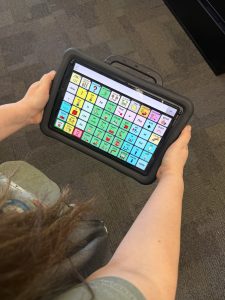
Corbin and Jaxson have very different AAC devices. While they are both tablets, everything else about them is set up to accommodate the two boys individually. The device that Corbin has would never have worked for Jaxson and vice versa, Raschka says. Each person’s communication needs are unique and AAC can be molded and shaped into whatever form best suits someone, whether that be a tablet loaded with an AAC language or eye-gaze tracking device or low-tech picture boards.
The traditional avenue for accessing AAC tools and devices is through a clinician or specialty clinic. But as the field has developed over the last decade, more and more tools have become available to the general public that don’t require going through a clinician or clinic. The highly diverse list of options and AAC’s intrinsic customizability has made AAC that much more accessible and open to anyone that could benefit from using it. Raising greater awareness of AAC and its abundant options could help those who may not have access to a clinician or clinic but could still find AAC helpful in their daily lives.
The key is figuring out what kind of AAC will be the best fit for each person. It is almost always a trial and error process as different options are tested. For those figuring it out on their own, this could mean trying out several different apps, potentially trying out an AAC language, or putting together some picture or letter boards. For others, who may have needs that are more complex or more significant communication difficulties like Corbin and Jaxson, working with a specialty clinic like the Waisman Center’s Communication Aids and Systems Clinic (CASC) could be helpful.
Waisman’s AAC-Focused Clinic
CASC, which is a part of Waisman’s University Center for Excellence in Developmental Disabilities, is a partnership between the Waisman Center and UW Health. Their team of speech-language pathologists (SLPs) and occupational therapist partner with families to provide highly specialized, cutting-edge AAC for children and adults experiencing significant communication difficulties. They work with people who have a range of disabilities such as cerebral palsy, autism, Down syndrome, Rett syndrome, ALS, spinal muscular atrophy (SMA), and more. “I can’t say enough good things about CASC,” Raschka says.
After an individual is referred to CASC, they start the multi-step process of being fitted with an AAC device. First up is a 90-minute evaluation. The SLPs take the time to get to know the individual and their family, how the individual is currently communicating, and where their strengths and areas of need are. All of that information gives the SLPs clues towards what kinds of AAC devices may be suitable.
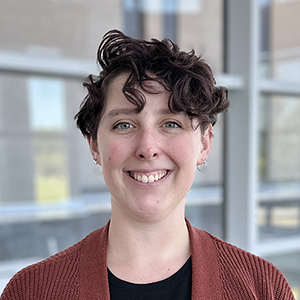
The SLPs will then take out different options, ranging from low-tech (such as laminated picture and letter boards) to high-tech (such as tablets loaded with AAC languages), to see which ones the individual is drawn to, is able to navigate, and matches their needs, asking a thousand questions along the way. “How many buttons can they handle on a page? How complex a language can they handle having? How should it be organized? How heavy can the device be? How will they access it? Can they reach out and touch it? Or do they need to use a switch or eye gaze?” says Prevost. This list is far from exhaustive as the SLPs evaluate a multitude of factors during each evaluation.
This process is called feature matching as the individual and family decide what things are important for the device to be able to accomplish and which option fulfills as many of those as possible. “Rebecca [Stroschein] brought in three or four devices for Corbin and we just kind of played with them. Then she asked a whole bunch of questions, very personal questions about him and what he liked and needed,” Raschka says. “It was very personable and she just did a really great job tailoring everything to him. It was the same way with Jaxson too.”
The team’s long list of questions and intentional feature matching process is intended to find a personalized and individual solution for each person. This process also often evolves over time as well, as an individual’s needs change. Feature matching can evolve over time and is not finalized after a single evaluation.
CASC is unique in that it also employs an AAC-specialized occupational therapist (OT) in the evaluation process. “We are very lucky to have an OT who specializes in access to communication devices,” Prevost says. “If AAC-focused SLPs are uncommon, AAC-focused OTs are nearly non-existent.”
Cassel, CASC’s OT, focuses on figuring out the best way for a person to access their communication device. She helps determine the best way for the person to navigate their device, what should the display or screen look like if there is a screen, are there sensory needs that need to be considered, and how they can best bring their device with them. “It’s all about determining the best setup for them so it can be a functional part of their everyday lives,” Cassel says. Similar to feature matching, device set up is never officially finalized and can be altered and adapted as needed.
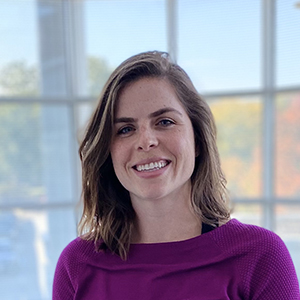
The combined expertise of SLPs and OTs helps create more successful feature matches and makes the devices more accessible to the individuals. “Our collaborative process is vital as we can play off of each other in real time. It is such a gift,” Cassel says. “It is so easy to make the wrong match and have someone never use their device. It is a lot to figure out and if it isn’t quite right, they’re not going to use it. Having both disciplines in the clinic is really important to make sure that the device is really going to jive in the person’s life.”
After the evaluation, the individual trials their new device for a month to see how it works for them outside of a clinical space. If it ends up being a good fit, the CASC team puts together a treatment plan where the individual will come back for a series of appointments where they continue to work on optimizing the layout of the device, customizing the language and buttons to meet their specific needs, building out a social repertoire, and further developing operational and navigation skills. Skill building and goal-oriented appointments can continue as long as the patient needs. If the device isn’t a good match, CASC will continue to work with the individual to find a device that is.
Raschka says the most frustrating thing is the wait in between the end of the trial and getting the official AAC device. “We made a spot in our house where Corbin’s device sits so he knows where it is at all times,” Raschka says. “And for those few weeks that we were waiting, he was so frustrated that he couldn’t use it. It was like we finally gave him a voice and then we had to take it away.”
Expanding AAC access beyond the Waisman Center
As a small highly-specialized clinic, CASC often runs into the issue of capacity. There are simply not enough AAC-trained SLPs and OTs to address the amount of need. CASC’s Partnership Program is an effort to work with professionals to support their ability to provide AAC. The program has a more consultative model where CASC SLPs will meet with other SLPs to talk them through the process of getting devices, give them access to resources and checklists, and be an overall support point.
The hope is that this will enable more SLPs to feel comfortable working with AAC devices which will make it easier for more individuals to get access.
The CASC team is constantly working to help as many people as possible get access to communication. It is easy to see how fiercely passionate they are about the work that they do. Communication is more than just the ability to say that you’re hungry or that you want a specific thing. It’s how people can connect with, influence, and be a part of the world around them and everyone deserves access to that regardless of the form it takes.
“As a parent, them getting a device and using it is no different than hearing your kids speak for the first time. I cried so hard with Corbin the first time he pushed that button. It was like him talking to me for the first time,” Raschka says. “It is invaluable.”