
Marsha R. Mailick, PhD – Slide of the Week
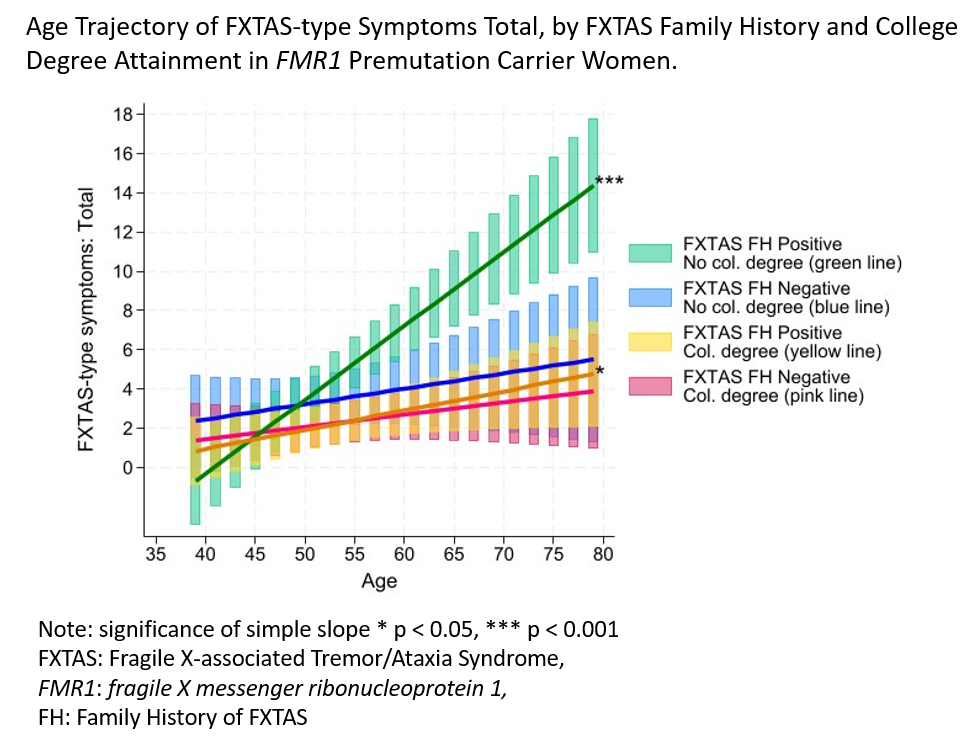
Title: Age Trajectories of FXTAS-type Symptoms Total score by FXTAS Family History and College Degree Attainment in FMR1 Premutation Carrier Women
Legend: Graphical representation of longitudinal trajectories of FXTAS-type symptom scores in FMR1 premutation carrier women with 95% confidence intervals. The trajectories of FXTAS-type symptom scores were linear, but varied by family history of FXTAS and further by educational attainment (obtaining a college degree). The FMR1 premutation carrier women who were FXTAS Family History Positive had age-related trajectories of significantly worsening FXTAS-type symptoms, but the trajectories diverged depending on whether they had attained a college degree. Those without a college degree (green line) had steep age-related increases in their total FXTAS-type symptoms, while such symptoms in those who had attained a college degree (yellow line) increased more gradually with advancing age. The age trajectory of those without a college degree worsened significantly starting at age 51 as compared with those who had a college degree. In contrast, the age-related trajectories of the FMR1 premutation carrier women who were FXTAS Family History Negative were not significant, remaining relatively low across the age range, regardless of college degree attainment (blue and pink lines).
Citation: Hong, J., DaWalt, L. S., Klusek, J., Berry-Kravis, E. M., & Mailick, M. R. (in press). Interaction of FXTAS Family History and College Degree Attainment Predicts Trajectories of Cognitive and Motor Symptoms in FMR1 Premutation Carrier Women. American Journal of Medical Genetics, Part B: Neuropsychiatric Genetics.
Abstract: The present longitudinal study focuses on FMR1 premutation carrier women during midlife and early old age (n = 115). Bringing together the genetic risk factor of a family history of FXTAS and the environmental protective factor of higher education, the goal of the study was to determine how these factors potentially interact to predict self-reported FXTAS-type symptoms in women carrying the FMR1 premutation. We investigated age-related changes in symptoms, measured prospectively over a decade. Using an accelerated longitudinal design approach, we estimated trajectories of change extending from early midlife (starting at age 39) into older age (up to age 80) in a community-based cohort. Results indicated that women with the FMR1 premutation who have a family history of FXTAS are at greater risk for experiencing symptoms during late midlife and older age than those who do not have such a family history. Consistent with research on other neurodegenerative diseases, this family history risk may be moderated by completing a college education, suggesting that cognitive enrichment during a period of neuroplasticity might provide protection from the neurodegenerative symptoms that are experienced by some women with the premutation as they age.

Investigator: Marsha R. Mailick, PhD
About the Lab: The Lifespan Family Research Program is dedicated to the advancement of knowledge about families who have a member with intellectual and developmental disabilities with a special emphasis on how these families change over the lifespan. Our program of research focuses on autism, fragile X syndrome and other developmental and mental health conditions. We study cohorts of families who have generously volunteered to be members of our longitudinal research, and we are extremely grateful to them for their continued participation. In addition, we study representative population cohorts including the Wisconsin Longitudinal Study, the Midlife in the United States (MIDUS) Study, and Personalized Medicine Research Project of the Marshfield Clinic.