
New Waisman Investigator brings focus to the connection between vision and the brain
By Emily Leclerc | Waisman Science Writer
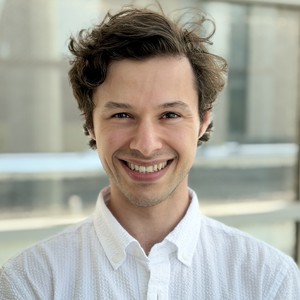
When Jonathan Soucy, PhD, was a child, he learned that a congenital cataract would keep him from fulfilling his dream of becoming an astronaut. Decades later, that same childhood experience has come full circle. Now, as a new Waisman Center investigator and assistant professor of biomedical engineering at UW–Madison, Soucy is working to understand the connection between the eye and the brain and develop new ways to restore vision.
Soucy comes to the center from Harvard Medical School, where he was a postdoctoral fellow. His path to vision research did not begin with a plan to study vision. As a child, Soucy dreamed of becoming an astronaut. But being born with a congenital cataract, which was not corrected until he was around four years old, ultimately made that career path impossible.
Instead, his interests gradually shifted from space exploration and aerospace toward understanding and engineering biological systems. He moved from chemistry to chemical engineering to tissue engineering before eventually studying the cardiac nervous system during his PhD program. But as he was about to turn 26, his path shifted again.
“I was about to turn 26 and age out of my parents’ health insurance, so I figured I should get all of my checkups in while I still could,” Soucy says.
At the eye doctor, a resident was puzzled that Soucy’s vision in one eye was so poor, yet he wasn’t wearing glasses or contacts. The physician came in to consult and explained that Soucy’s poor vision in that eye was due to deprivation amblyopia and how the condition had developed. The explanation would later help shape his interest in vision research.
“The doctor told me I had something called deprivation amblyopia, and it was the first time I’d ever heard the term,” Soucy says. “Because I was born with a cataract and it wasn’t corrected until I was a few years old, my brain never learned to properly use the information coming from that eye. Essentially, the eye could receive visual information, but the connections between the eye and brain hadn’t developed normally. And I remember thinking, ‘That’s really interesting. I could study that.’”
Today, Soucy’s research lab seeks to understand how communication between the eyes and the brain is established during development and use that knowledge to develop therapies to restore vision. His lab, called the NERV Lab (Neural Engineering for Restoring Vision), studies retinal ganglion cells (RGCs), which are neurons that transmit visual information from the eye to the brain. Soucy’s recent projects focus on RGC transplantation and understanding how transplanted neurons can survive, integrate into existing retinal circuits, and ultimately reestablish connections between the eye and brain.
He is thrilled to be part of the Waisman Center and immersed in the center’s interdisciplinary environment.
“I’m really excited to build collaborations with so many of the people here and to have access to Waisman’s incredible resources and facilities,” Soucy says. “One of my major goals is to eventually translate some of the work we do in the lab into therapies that can restore vision for patients, and Waisman is a great place to start building toward that.”
When Soucy is not in the lab, he is outside exploring Madison with his wife and dog. “A lot of our lives revolve around taking care of our dog, Jasper, and it is really fun,” he says. From long walks and hiking to bike rides and the many events and festivals Madison hosts, he is often out and about. He is enjoying all that Madison has to offer.
Soucy was recently awarded a large major grant from the National Eye Institute, which is part of the National Institutes of Health, to support his transition into an independent researcher and launch his new research pursuits.