
From Lived Experience to Leadership: Jack Hoselton’s Advocacy Journey with WI LEND
By Charlene N. Rivera-Bonet | Waisman Science Writer
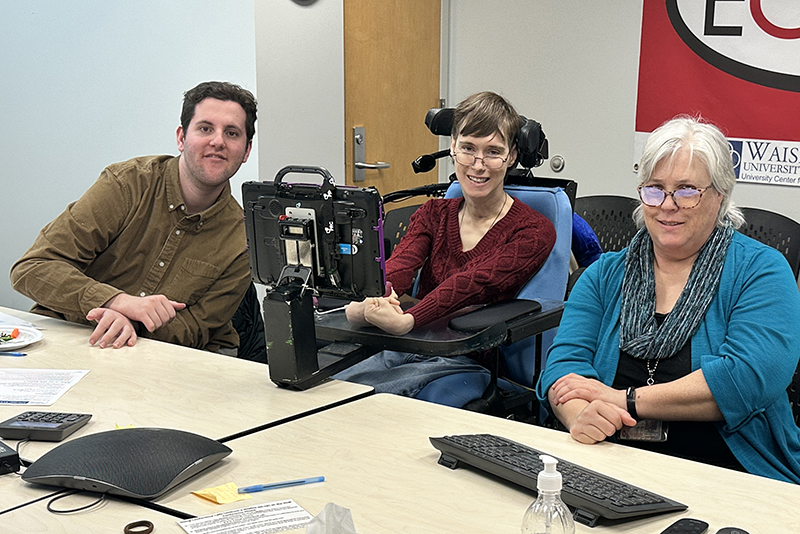
Jack prefers the use of person-first language with reference to him and his autism diagnosis. The language used in this story reflects that preference.
Jack Hoselton strives to improve society for people with disabilities. His own lived experience as a man with autism gives him an understanding of the disability world, its strengths and its challenges. Still, he wanted to learn more about other individuals’ experiences, and how to advocate for himself and for others. The Leadership Education in Neurodevelopmental Disabilities (LEND) Program is giving him the tools, knowledge, and confidence he needs to do this.
Hoselton is a student at Edgewood College’s Cutting-Edge Program and is set to graduate in May of 2025 with a Bachelor of Arts in studies in education. He is also a two-year LEND trainee in disability advocacy.
LEND is a special training program funded by the federal Maternal & Child Health Bureau of the Department of Health & Human Services. The WI LEND training program is part of the University Center for Excellence in Developmental Disabilities at the Waisman Center. The program educates emerging leaders on how to improve services and supports for children with or at-risk for neurodevelopmental diseases by training healthcare professionals, self-advocates, and family members.
Hoselton learned about LEND through school, and he felt like it was a good program to pursue, “…not only to learn how to advocate for other people with disabilities, but also to learn ways of self-advocacy and how I could improve society for people with disabilities using my own lived experience,” he explains.
With one year of training under his belt, he feels like it’s been an amazing experience that has given him new understanding beyond his own experience with disability. “I feel like I’ve gained a lot of knowledge about how people see the world through their experience with a disability,” Hoselton says. This knowledge, he explains, has given him a greater understanding of what needs to be done better to improve lives for those with disabilities.
Everyone comes to LEND with unique perspectives and expertise, and the interdisciplinary nature of the program allows trainees to not only grow in their own areas of expertise, but also gain a better understanding of other fields and how they can work together. “Working with these different disciplines, I feel like there’s something to be said about the ability to not only connect with these people, but also share ideas,” Hoselton says. Part of the advocacy work, he explains, starts with exchanging ideas with professionals about how to improve things like the diagnostic process, or how they treat people with disabilities. “I feel like it starts with making the connections I’ve made with the different people in the different disciplines. I feel like that’s a huge part of LEND that I really enjoyed,” Hoselton says.
Julie Schears, who has been a LEND disability advocacy training coordinator for more than a decade, has been mentoring Hoselton through his training. “She’s been great. I’ve enjoyed getting to work with her, and I’m excited to continue to work with her next year as well,” Hoselton says.
Schears helped Hoselton feel confident and ready to meet with Wisconsin legislators during Disability Advocacy Day in 2025. Leading up to it, the LEND team helped Jack prepare his story on how Medicaid has impacted his life, and how cuts to it could be detrimental to his independence, access to services, healthcare, and more. During Disability Advocacy Day, Hoselton spoke with Wisconsin legislators and told them his story, to advocate not only for himself, but also for everyone with a disability whose life could be impacted by these cuts.
As Hoselton finishes up his bachelor’s degree, he is thinking about working in healthcare, and hopes to become a medical assistant. He also plans to continue his advocacy work. “I do plan on starting a career as a long-term advocate and starting to go on and talk at schools and all these other places to make society better for people with disabilities,” he says. “I feel like there’s a lot of stuff we need to improve on.”