
Krishanu Saha, PhD – Slide of the Week
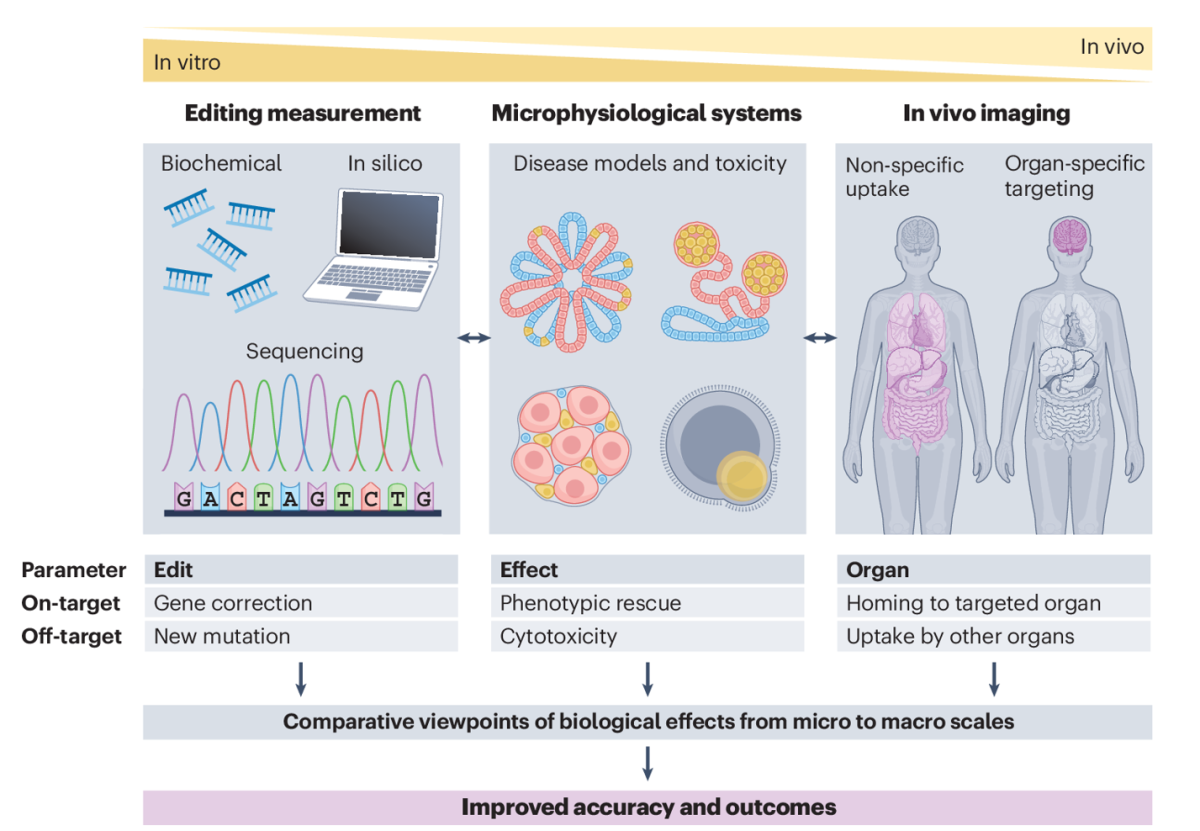
Title: How safe is genome editing? Tracking biological effects in somatic cells
Legend: Editing measurements, microphysiological systems (such as organoids and organs-on-chips) and in vivo imaging techniques present a spectrum of information across different scales, from single nucleotides in vitro to the whole body in vivo. The precise meaning of ‘on-target’ and ‘off-target’ is specific to each scale and assay, each focusing on a particular parameter, for which examples are provided (respectively, for on-target and off-target). Comparative analysis of results from different scales, together with inputs from traditional model systems (Box 1), can produce a holistic understanding of the therapy. Ultimately, this leads to more facile regulatory processes and successful outcomes in the clinic.
Citation: Freedman, B.S., Bulte, J.W.M., Conklin, B.R. et al. Monitoring biological effects of somatic cell genome editing. Nat Rev Genet 27, 323–342 (2026). https://doi.org/10.1038/s41576-025-00916-0
Abstract: CRISPR-based genome editing therapeutics are entering the clinic, offering transformative potential but also presenting potential risks. Preclinical-to-clinical toolkits are needed to assess the safety and efficacy of these new therapies and accelerate progress. Emerging technologies to monitor the biological effects of genome editors cover a range of biological scales, from the direct measurement of editing outcomes in DNA, to human microphysiological systems, and non-invasive in vivo imaging. Measurements of on-target and off-target editing outcomes, including sequences unique to humans, provide essential benchmarks to understand functional responses. Microphysiological systems, including organoids and organs-on-chips, enable phenotypic evaluations of editing strategies in varied organ lineages and disease states. Non-invasive imaging modalities can track the biodistribution and activities of genome editors and edited cells in vivo. Collectively, these technologies provide complementary insights across different scales, from the single nucleotide to the whole organism, bridging preclinical therapeutics development with clinical trials.

Investigator: Krishanu Saha, PhD
About the Lab: The Saha Lab (Kris Saha) is affiliated with several multi-disciplinary centers including the Waisman Center, Wisconsin Institute for Discovery and the Stem Cell and Regenerative Medicine Center at UW–Madison. Our research dedicated to using human stem cells together with emerging engineering methods in material science and synthetic biology to make smarter therapeutics, model human disease, and advance personalized medicine. We are collaborative efforts on campus in biomanufacturing cell and gene therapies, and nationally with the NIH Somatic Cell Genome Editing program and the NSF Center for Cell Manufacturing Technologies.