
Luigi Puglielli, MD, PhD – Slide of the Week
Title: Overexpression of ATase1 and ATase2 disrupts the secretome and causes a progeria phenotype
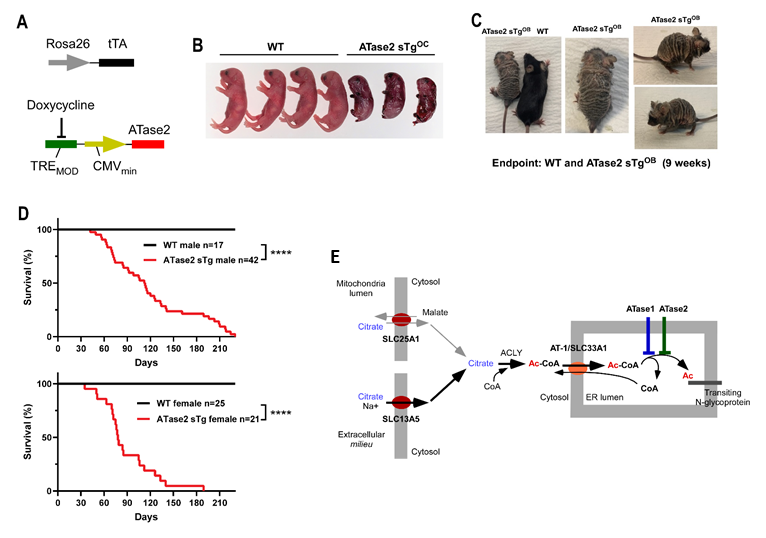
Legend: Gene duplications events affecting ATase1 and ATase2 are associated with rare forms of ASD with intellectual disability and progeria. Here, Cheng et al. show that mice with systemic overexpression of either ATase1 or ATase2 develop a similar phenotype. Panel A shows the design of the mouse. Panel B shows the lethality of ATase2 overexpression during embryogenesis. Panel C shows the progeria phenotype caused by ATase2 overexpression at birth. Panel D shows the lifespan of ATase2 overexpressing mice. Panel E shows the ATases downstream of the citrate/acetyl-CoA pathway. The entire citrate/acetyl-CoA pathway has been linked to rare forms of ASD with intellectual disability and progeria.
Citation: Cheng TL, Wu F, Haque ME, Thiel AR, Wang D, Helgager JJ, Li L, Puglielli L. Life Sci Alliance. 2025 Sep 10;8(12):e202503378. doi: 10.26508/lsa.202503378. PMID: 40930841; PMCID: PMC12423556.
Abstract: Nε-lysine acetylation in the lumen of the ER requires two acetyltransferases, ATase1/NAT8B and ATase2/NAT8. They are type II membrane proteins and belong to the larger GNAT superfamily of acetyltransferases. Their enzymatic activity is tightly coupled to the import of acetyl-CoA in the lumen of the ER by AT-1/SLC33A1. Gene duplication events involving 3q25.31 (harboring AT-1/SLC33A1) and 2p13.1 (harboring ATase1/NAT8B and ATase2/NAT8) are associated with autism spectrum disorder with intellectual disability and progeria-like dysmorphism. Here, we report the generation and phenotypic characterization of mice with systemic overexpression of ATase1 (ATase1 sTg) and ATase2 (ATase2 sTg). Overexpression of either ATase at conception was found to be lethal while overexpression at birth was found to cause a progeria-like phenotype that included skin alterations, lordokyphosis, reduced bone density, sarcopenia, splenomegaly, adenomegaly, and systemic inflammation. The phenotype of ATase1 sTg mice displayed incomplete penetrance, while the phenotype of ATase2 sTg displayed full penetrance and was more severe. Mechanistically, the phenotype was linked to altered dynamics of the secretory pathway with defects affecting the quality of the secretome.

Investigator: Luigi Puglielli, MD, PhD
About the Lab: The Puglielli Lab’s research interests focus on molecular mechanisms of neurodevelopment and neurodegeneration. The laboratory employs a combination of biochemical, cellular, molecular, and genetic approaches in in vitro, ex vivo and in vivo models. In 2007 the lab reported that nascent proteins could undergo Nε-lysine acetylation in the lumen of the endoplasmic reticulum (ER). This discovery resulted in the identification of a previously unknown biochemical machinery that impacts on the biology of the ER.