
Ari Rosenberg, PhD – Slide of the Week
Title: A semi-automated spike sorting method for the assessment of multi-electrode array (MEA) data from cultured stem cell-derived neurons
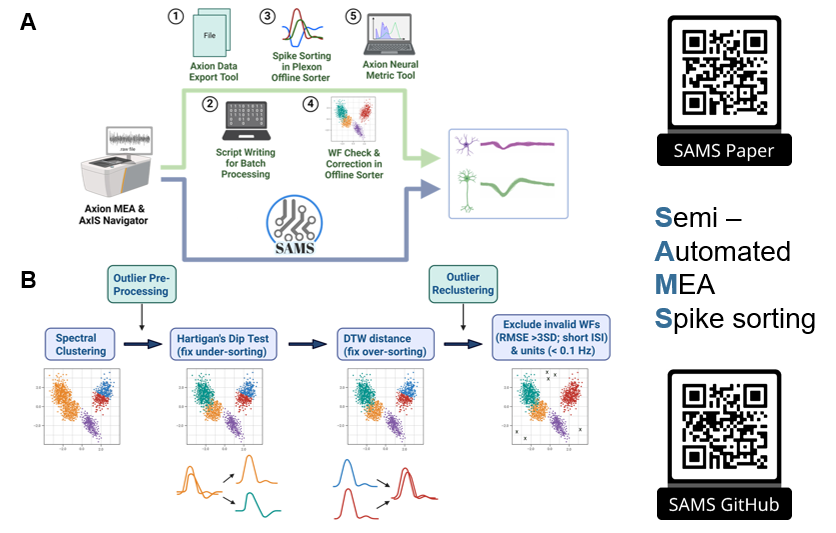
Legend: A. Top: The standard pipeline for spike sorting Axion MEA data involves multiple software tools and manual steps. Bottom: The pipeline for analyzing Axion MEA data using SAMS. Our streamlined process directly interfaces with AxIS Navigator output files and performs automatic batch processing. B.Schematic of SAMS processing stages: (1) spectral clustering to perform initial waveform clustering, (2) outlier waveform preprocessing, (3) Hartigan’s dip test to resolve undersorting, (4) Dynamic time warping (DTW) distance calculation to resolve oversorting, (5) outlier reclustering, and (6) exclusion of invalid units based on spike waveform (WF), frequency, and inter-spike interval (ISI) criteria. Scan the “SAMS Paper” QR code at the top right to read our recent paper in Stem Cell Reports. The “SAMS GitHub” QR code on the bottom right takes you to everything you need to start using SAMS.
Citation: Xiaoxuan Ren, Carissa L. Sirois, Raymond Doudlah, Ethan E. Dayley, Natasha M. Mendez-Albelo, Aviad Hai, Ari Rosenberg, and Xinyu Zhao. Ren et al., A semi-automated MEA spike sorting method for high-throughput assessment of cultured neurons, Stem Cell Reports (2026)
Abstract: Neurons derived from human pluripotent stem cells (hPSCs) are valuable models for studying brain development and developing therapies for brain disorders. Evaluating hPSC-derived neurons requires assessing their electrical activity, which can be achieved using multielectrode arrays (MEAs) for extracellular recordings. Because each electrode channel generally detects activity from multiple neurons, resolving the activity of single neurons requires a process called spike sorting. However, currently available methods were not developed for analyzing data from hPSC-derived neurons and require complex workflows and time-consuming manual intervention. Here, we introduce a semi-automated MEA spike sorting software (SAMS) designed specifically for low-density MEA recordings of cultured neurons. SAMS outperforms commercially available automated spike sorting algorithms in terms of accuracy and greatly reduces computational and human processing time. By providing an accessible, efficient, and integrated platform for spike sorting, SAMS enhances the resolution and utility of MEA in disease modeling and drug development using hPSC-derived neurons.
About the Lab: The Rosenberg Lab studies the neural computations underlying 3D vision, multisensory integration, and the neural basis of autism.