
New screening platform accelerates search for Rett syndrome treatments and reveals new disease mechanisms
By Emily Leclerc | Waisman Science Writer
At a Glance:
- Screening libraries of already approved drugs for potential repurposing is a quicker and more cost-effective method for finding new potential treatments for different conditions.
- Waisman investigator Qiang Chang, PhD, has developed a new drug screening platform for Rett syndrome, a rare neurodevelopmental genetic disorder, to help improve the first steps of developing a new treatment.
- Chang and his lab found that their drug screening platform is fast, efficient, and capable of generating new insights into Rett syndrome’s molecular underpinnings.
- Using the platform to screen a library targeting disease-altered genes, Chang and his lab found new genes that were previously unknown to be functionally relevant in Rett syndrome. This discovery could help them better understand cell to cell interactions in the condition.
Developing treatments for rare genetic disorders, such as Rett syndrome, is notoriously difficult, often requiring years of research and significant financial investment. Researchers at the Waisman Center, University of Wisconsin–Madison have developed a new drug screening platform for Rett syndrome that could help accelerate the search for potential therapies while uncovering new clues about the biology of the disease.

(Photo by Jeff Miller / UW–Madison)
The platform, developed by Qiang Chang, PhD, director of the Waisman Center and professor of medical genetics and neurology at UW–Madison, provides a fast and efficient way to evaluate existing drugs for possible repurposing. The system also enables researchers to identify genes and cellular pathways that contribute to Rett syndrome, a rare neurodevelopmental disorder that causes severe cognitive, motor, and communication impairments.
Rare diseases often lack effective treatments because there are typically less resources being invested into finding and developing them. Screening already safety tested and/or FDA-approved drugs for possible repurposing is a way to find potential new therapies that bypasses much of the initial research investment required of brand-new drugs.
Using the discoveries and insights garnered after years of studying Rett syndrome, Chang and his lab developed a new and powerful drug screening platform for the condition. It utilizes a simple staining test, a stem cell model of the condition, and a prominent deficit in Rett syndrome mitochondria.
Designing the new screening platform
Astrocytes, a crucial multifunctional cell type in the brain, have been shown by both Chang and other researchers to be important cells in Rett syndrome. Deriving astrocytes from Rett syndrome specific stem cells, Chang and his team are able to create a reliable cellular model of disease relevant symptoms that is easy to study and measure. In particular, Rett syndrome astrocytes display several pronounced issues in their mitochondria, which are organelles specializing in synthesizing cellular energy.
“We published a previous paper that described when human astrocytes have the genetic mutation that causes Rett syndrome, they have a whole series of issues with their mitochondria. The one we focused on was this mitochondrial membrane potential deficit because it is very easy and quick to measure,” Chang says.
To screen a library of drugs for repurposing, you need a platform that can effectively tell if the drug is having the desired effect. With a simple staining test, Chang and his lab found that it was incredibly easy to see if, when treated with a drug, the astrocytes’ mitochondria membrane deficit was being reversed. “We found a good cell model, an easily measured characteristic, and an accurate test for it. That opens the door for high volume drug screening,” Chang says. They outline its functionality in their new paper published in the journal Frontiers of Neurology.
The platform works by putting a number of astrocytes in individual wells. Then using robotic dispensers, each well is treated with a different drug. From there, the staining test can quickly be used to assess if the drug is impacting the astrocytes’ mitochondrial deficit or not. This method allows Chang and his team to easily screen through hundreds or thousands of compounds in search of candidates that are effective.
“That is the core part of this paper, that we developed this new platform that not only my lab but others can use. It is flexible too. You don’t have to screen mitochondria it can be something else as long as you have a good test for it,” Chang says.
The first library Chang decided to screen was one that contained over a thousand FDA-approved drugs. The screening revealed several potential candidate drugs that reversed the mitochondria deficit. One even rescued other mitochondrial issues as well. Finding candidate drugs is only the very first step in potential drug repurposing but it shows their new screening platform is effective.
Using the platform to uncover molecular insights
The second library consisted of siRNA (small interfering RNA) targeting over three hundred genes that are overexpressed in Rett syndrome astrocytes. siRNA are used to ‘silence’ genes by preventing them from producing proteins. “We know in astrocytes there are gene expression changes caused by Rett syndrome but we don’t know which of these changes are important to disease phenotypes at the cellular level. The siRNA screening let us look at all the genes that are overexpressed in these cells by using specific siRNAs to silence each gene and see which silencing would rescue the deficits,” Chang says. “This allowed us to look at the transcription basis of the deficits.”
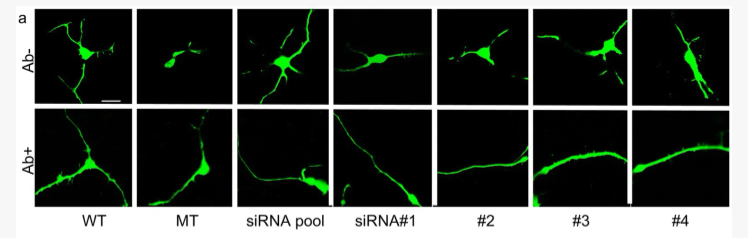
Chang and his lab found new genes that were previously unknown to be functionally relevant in Rett syndrome. One of the new genes is particularly interesting because it could help explain how astrocytes are impacting the functions of neurons in the condition. “The gene makes a secreted peptide which is overproduced in Rett syndrome astrocytes. We could demonstrate specifically that the overproduction of this peptide was affecting neuronal function,” Chang says. “This is a novel pathway that could help us understand cell to cell interactions in Rett syndrome.” Moving forward, Chang and his team want to explore this new pathway more to start to understand it better. Determining how and why astrocytes are influencing neurons could provide potential new treatment targets. Their new drug screening platform provides them with the ability to not only continue looking for potential candidate drugs, but to also explore new mechanistic details underlying Rett syndrome.