
Parents as partners: How a community advisory council highlights the importance of learning from lived experience in research
By Emily Leclerc | Waisman Science Writer
At a Glance
- Waisman investigator Bernadette Gillick joins an ever-growing cohort of Waisman investigators that have community advisory councils as parts of their lab. Gillick’s is called the Neonatal Family Research Advisory Council or NFRAC. (Jump to this content)
- With much of Gillick’s research recruiting families in the NICU, she and her collaborators that also conduct research in the NICU felt it was important to bring in the families’ perspectives and feedback to improve their research by making it more responsive to families’ needs, priorities, and concerns. (Jump to this content)
- During the council’s first year, the team put together a list of best practices on how to approach families in the NICU about participating in research. Their 2026 project is to develop a brochure that can be handed out in the NICU that explains the importance of research, how it helps improve care for babies, and mentions what studies are currently recruiting. (Jump to this content)
- The parent perspective is incredibly important in NICU research. NFRAC member Michael Rebarchik wasn’t sure what value he could add as he is not an expert in neonatal research or medicine. But he realized that a parent’s perspective is unique and that he and other families can offer insight that the research team likely doesn’t have. (Jump to this content)

Researchers are increasingly recognizing what families have long known: lived experience is its own form of expertise. At the Waisman Center this shift is taking root as more labs, including Bernadette Gillick’s, PhD, MSPT, bring community members directly into the research process through dedicated advisory boards, like the Neonatal Family Research Advisory Council (NFRAC).
Gillick, a Waisman investigator and professor of pediatrics at UW–Madison, is the next to join an ever-growing cohort of Waisman investigators that have community advisory councils as part of their lab. The councils are intended to bring in the perspectives, feedback, and advice from the community that a researcher is working to serve. NFRAC was formed a little over three years ago by Gillick and Matt Harer, MD, neonatologist at UW Health, associate professor of pediatrics at UW–Madison and has become a crucial part of how Gillick and her collaborators conduct their work. The NFRAC team recently published about the council in the Journal of Perinatology.
Having a child in the neonatal intensive care unit (NICU) is something no parent wants. It is a difficult and often traumatizing experience that comes with unique concerns and challenges. “Until you’ve had a baby in the NICU, it’s really hard to understand what that’s like,” says Harer. “Even for us researchers and clinicians, we don’t understand from the parent perspective what it’s like to deliver a baby and then have them whisked away to the NICU.”

With Gillick’s research focusing on neuroplasticity and recovery after a brain injury, in both pediatric and adult populations, many of her research studies recruit families directly from the NICU. Harer conducts research on neonatal kidney disease alongside taking care of babies in the NICU. They both realized that engaging with the community they are trying to serve and learning from their experiences and priorities would not only benefit their work but would hopefully benefit the families as well.
“Trying to make sure we are engaging with the community should be a priority for all researchers,” Gillick says. “So, we wanted to do something specific to understanding, in the NICU, how can we improve our studies. This is a very challenging time for families, so we couldn’t use all the recommendations or constructs for a typical community advisory board. We knew we had to do something distinct.”
A council built on partnership
NFRAC is composed of two parts, family council members and medical council members. The two groups meet both separately and together to review and provide feedback on study-related content, work on current projects, learn about ongoing research, and for council planning and organizing. The goal is for the council to be an avenue for families to talk about their experiences, priorities, questions, and concerns while providing advice and feedback to the researchers.
“Oftentimes they surprise us with what they want to tell us, or what we would potentially assume about what the families would want,” says Veronika Mak, MSc, research program coordinator in Gillick’s lab who also helps coordinate and manage NFRAC. “Then we learn from them that their perspective is very different. This is invaluable to us as researchers, as we build, develop, and implement research.”
Over the first year of the council, their big project was putting together a list of best practices on how to approach families in the NICU about participating in research. Harer says it is easily one of the most important things to come out of the council so far.
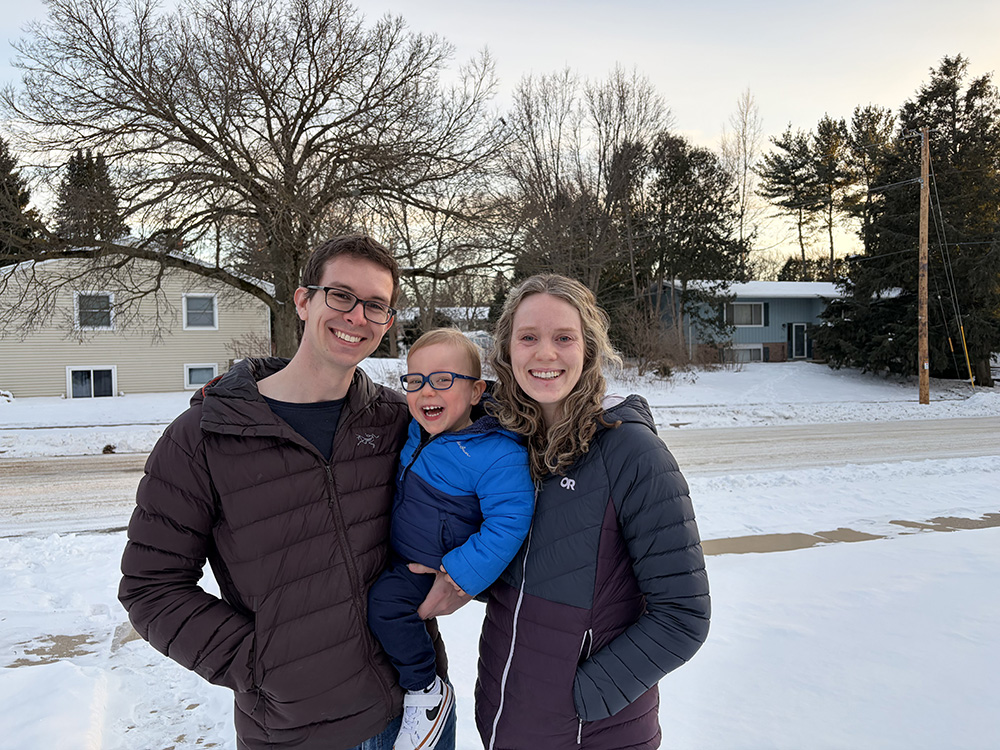
“Perception really matters,” says Michael Rebarchik, NFRAC member. His son spent a total of six months in the NICU between the end of 2023 and beginning of 2024. “Understanding the parents’ perspective is really important. Many aspects are hard to recognize as potentially overwhelming or upsetting unless you’ve been in the situation, especially because the mindset you have in the NICU setting differs drastically from when you are at home.”
Rebarchik, alongside the other council members, helped Gillick and Harer pin down not just when it is most appropriate to approach families but what language to use and how to talk about research participation. Those best practices are now being utilized for research studies conducted within the UnityPoint Health Meriter NICU and Newborn Nursery. The council has also reviewed and provided feedback on consent forms, research protocols, and recruitment materials for several developing neonatal studies.
Harer and Gillick both see how bringing together multiple perspectives and those with lived experience creates a richer and deeper view on research and how that can ripple beyond their own individual labs.
“Having the parents talk with us about all of these things really informs us and helps us make better clinical research protocols, write better consent forms, and hopefully in the future, even potentially design research studies together,” Harer says. “Then we can look at outcomes that are more important and family-focused than some of the outcomes that we currently look at in the NICU.”
Lived experience has an important place in research
Upon joining NFRAC, Rebarchik wasn’t sure about the impact he could have. He joined when his son was still in the NICU, hoping to share his experiences to help improve how care and communication are handled for other families. “When you hear research, it can be intimidating. These people are experts in the field, so it’s easy to question what value you can add as a parent.” Rebarchik says. “But that was very much not the case. My and others’ lived experience is something they really aren’t familiar with, so parents add a lot of value to the conversations.”
Being a part of the council for several years now, Rebarchik says it has been gratifying to see his and the council’s advice and feedback be taken seriously and integrated into the work that Gillick, Harer, and others are doing. Rebarchik says that being a part of the council has also been a way for him to continue to help parents even though his family is no longer in the NICU.
The council’s 2026 project is to design a brochure that can be handed out to parents in the NICU or expectant mothers staying in the hospital that explains why research is so important in the NICU space, how it helps move the field forward and improve care for babies, and that mentions current studies that are looking for participants. It will be a joint effort between NFRAC’s family and medical council members to ensure it is the right balance of approachable and informative.
For Gillick, Harer, and Mak, the council has been incredibly illuminating. For Harer – seeing that research is not often designed to be family-friendly, which can make recruitment challenging. For Mak – understanding the true amount of flexibility that is needed when designing studies focused around families is such a precarious place. And for Gillick – having the importance of learning from lived experience reinforced.
“I always have more to learn. When you are involved in a council like this, you realize you really need to understand how to team up with the community you serve. They are truly the experts, and we need to understand why they would participate in a research study,” Gillick says. “It’s also so important to understand what are the areas of concern that they have compared to the questions I am looking at researching.”
Rebarchik understands why families might be hesitant to join a council like this. Why they might also feel like they wouldn’t have much to add. But throughout his time on NFRAC, he’s realized the importance of continuing to connect researchers and the community.
“If this is something you are interested in, go for it. Most of the families involved in NFRAC, myself included, have no medical background, so it is by no means a prerequisite. But I really do think that we benefit from parents being involved because of their lived experience. Ultimately, the goal is to improve the experience for patients and families, and unless researchers get feedback, it’s hard to know what they need to fix.”
NFRAC is currently being supported by a grant from the Meriter Foundation.