
Damage to the cerebellum impairs ability to adapt speech timing and pitch, two new studies show
At a Glance:
- New research from the lab of Ben Parrell, PhD, found that individuals with cerebellar ataxia fail to adapt the timing of their speech in response to altered auditory feedback.
- A second study from Parrell found that individuals with cerebral ataxia show impaired adaptation of vocal pitch.
- These studies shed light on the role of the cerebellum in speech motor control.
Cerebellar damage may impair someone’s ability to adapt both the timing of speech and vocal pitch, new Waisman Center studies suggest, shedding light on the involvement of the cerebellum in speech motor control.

The studies were published by the lab of Ben Parrell, PhD, associate professor of communication sciences and disorders, whose lab aims to better understand the role of the cerebellum in speech motor control.
The cerebellum, a part of the brain located at the back of your head, plays a vital role in motor control. Cerebellar ataxia is a neurological condition caused by damage to the cerebellum, due to either genetic disorders causing neurodegeneration, or acquired injuries such as stroke or trauma, which typically leads to problems with movement that include speech impairments. “We have a pretty good handle on, if you have a particular neurodegenerative disorder, what are the likely speech symptoms that you’re going to present with,” Parrell says. “But understanding exactly why that happens is sort of a missing link often, and particularly so for the cerebellum.” Their goal is to better understand what is the role of the cerebellum in speech, and why damage to it leads to particular patterns of impairment.
Speech is a complex motor task involving more than 100 muscles across multiple body systems. “We have to coordinate all of those muscles in time to create this very precise movement that’s precise in both space and time,” Parrell says. “In terms of our tongue movements, if we miss by a few millimeters, or by a few 10s of milliseconds, we actually change the perception of the sound. We actually produce a different sound,” he adds.
In the first study, published in The Journal of Neuroscience, Parrell looked at how damage to the cerebellum affected temporal adaptation in speech, meaning how individuals adjusted the timing of their speech based on real-time feedback.
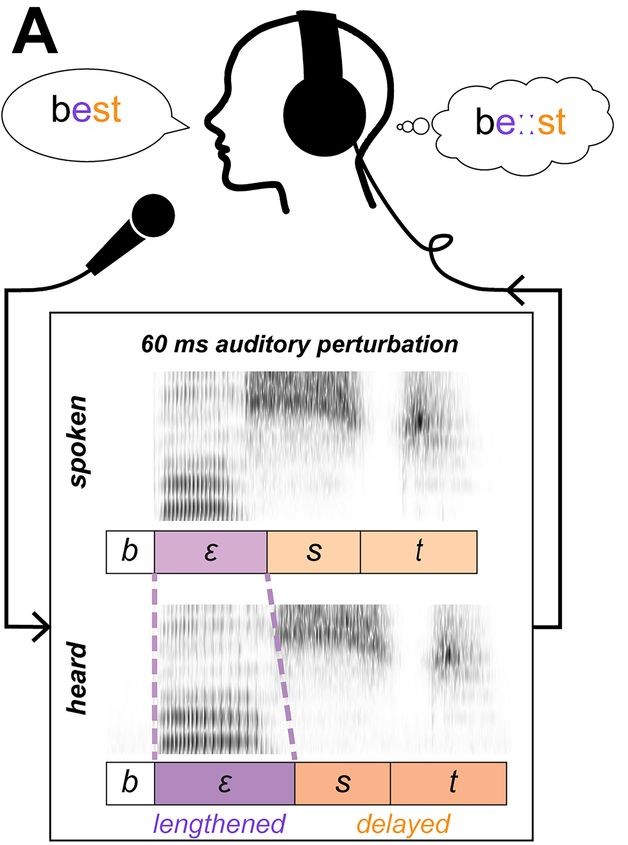
Individuals with or without cerebellar ataxia performed a speech adaptation task, where they said the word “best”, and received real-time feedback of their speech through headphones. For part of the trial, the researchers introduced what they call a perturbation, where they elongated the “eh” vowel sound – by such a short time that individuals couldn’t consciously notice – and measured how the individuals changed the timing of speech in response to that perturbation. “People should adapt by shortening their vowels in response to the lengthening that they hear,” Parrell explains. “Over time, over many exposures to this, what people without neurological disorders do is they start to produce this vowel shorter than they otherwise would have,” he adds.
One way we are able to maintain accurate movements in speech, as well as other motor systems, is by comparing the predictions of what we generate with the outcomes of our movements based on the sensory feedback we get. “For speech, it might be what we hear about our speech from our auditory system, or also the feeling, the sensation of the lips and the tongue and the jaw, that somatosensory signal that tells us where the body is in space,” Parrell says.
This type of motor adaptation is impaired in individuals with cerebellar damage. Parrell’s new research study suggests that the same idea applies to timing adaptation, or the perception of correct vowel duration.
Individuals with cerebellar ataxia who performed the task were not able to adapt the timing of their speech. “We think that might be important because, if people aren’t able to use feedback to maintain the timing of speech sounds, that might help us understand why the timing of speech is impaired in people who have ataxia,” Parrell explains.
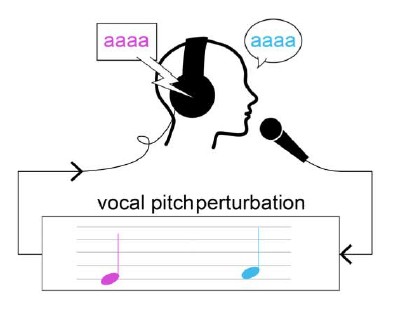
The second study published in the Journal of Cognitive Neuroscience by Parrell, tested whether adaptation to perturbations of vocal pitch, rather than timing, was also impaired in individuals with cerebellar ataxia. Results showed that individuals with cerebellar damage failed to adapt vocal pitch in the presence of perturbations, suggesting that the cerebellum also plays a role in maintaining accurate control of vocal pitch.
Currently, Parrell is using structural magnetic resonance images (MRI) in combination with behavioral tasks to try to map which regions of the cerebellum are involved in the different types of speech behaviors.
The ability to communicate, Parrell says, is fundamental to being human. “An impairment in communication often leads to social withdrawal, isolation, and then consequentially depression. So, these speech motor symptoms really have a severe impact on people’s lives,” he explains. Understanding the role of the cerebellum on these impairments may lead to more targeted interventions to improve communication in individuals with damage to the cerebellum.