
New drug shows promise for treating Down syndrome-related brain changes
By Emily Leclerc | Waisman Science Writer
At a Glance
- Waisman investigator Anita Bhattacharyya, PhD, and her lab have published new research showing that a new drug has potential to mitigate cellular deficits in individuals with Down syndrome.
- The drug, Leucettinib-21, targets an overexpressed gene in Down syndrome, DYRK1A.
- After treating neurons derived from Down syndrome induced pluripotent stem cells, Bhattacharyya and her lab found that Leucettinib-21 is effective in reducing the levels of DYRK1A to normal.
- Their results provide support for the drug’s continued movement through human clinical trials and potential hope for a new therapeutic to improve cognition in individuals with Down syndrome.
Individuals with Down syndrome have differences in how their brains form that cause intellectual disability. Down syndrome or trisomy 21 is the most common genetic cause of intellectual and developmental disability and is caused by the triplication of chromosome 21. New research from the lab of Waisman investigator Anita Bhattacharyya, PhD, suggests that an experimental drug may help address one of the biological mechanisms underlying those challenges.
In a study published in Disease Models & Mechanisms, Bhattacharyya, associate professor of cell and regenerative biology at the University of Wisconsin–Madison, and colleagues found that the drug Leucettinib-21 (LCTB-21) successfully reduced the activity of DYRK1A, a gene encoded on chromosome 21, in human neuron models of Down syndrome.
DYRK1A plays an important role in brain development and neuron function. The gene is dosage sensitive, meaning both too little and too much activity can disrupt normal development. “With DYRK1A, both underexpression and overexpression can be harmful,” Bhattacharyya says. “Maintaining the right level of activity is critical.” In people with Down syndrome, who have an extra copy of chromosome 21, DYRK1A is produced at elevated levels which can negatively affect how progenitor cells and neurons develop.
Because of its involvement in several neurodevelopmental and neurodegenerative conditions, including Down syndrome, DYRK1A has become an increasingly interesting therapeutic target. Research using DYRK1A inhibitor drugs in rodent models of Down syndrome and Alzheimer’s disease have shown improvements in cognition but the drugs have not been tested in relevant human cell models, Bhattacharyya says. “This type of testing is especially important in Down syndrome because rodent models don’t really mimic many of the features, especially in the brain, of what happens in people with Down syndrome,” she adds.
Through her lab’s previous work, Bhattacharyya connected with a small pharmaceutical company in France that is developing DYRK1A inhibitors. Perha Pharmaceuticals developed LCTB-21, a drug that reduces DYRK1A activity, and they have been particularly interested in testing its effectiveness in Down syndrome.
“They have tried LCTB-21 and some predecessor drugs on mouse models of Down syndrome and saw some positive effect. But it had never been tested on human cells or human neurons and that is where you would like to know if it has an effect,” Bhattacharyya says. “So, we decided to work together to do the testing.”
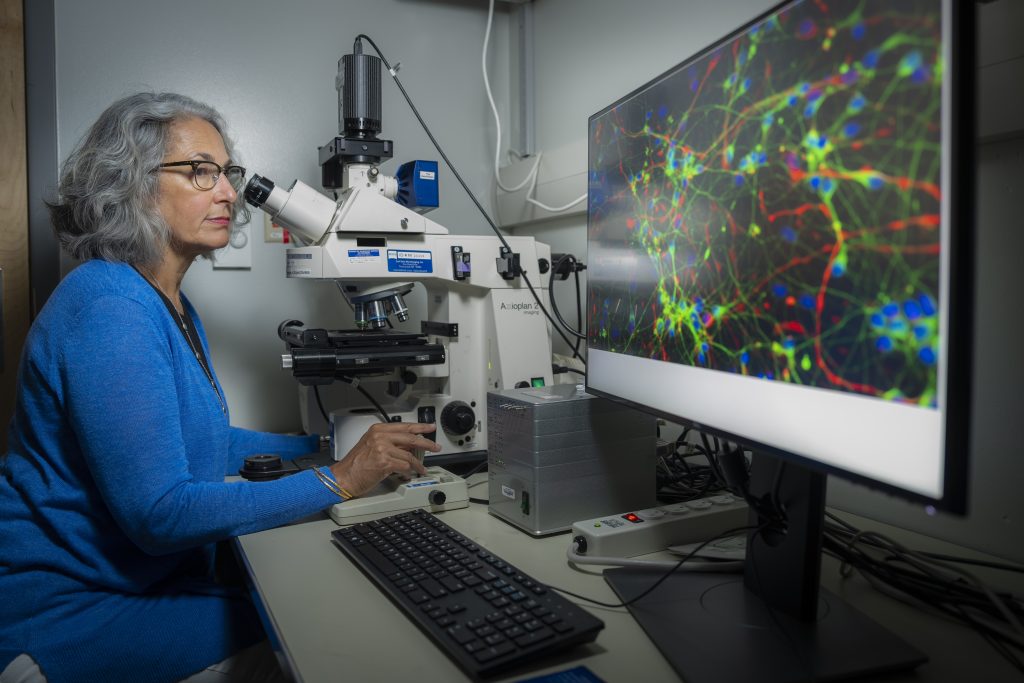
After treating neurons derived from Down syndrome induced pluripotent stem cells (iPSCs) with LCTB-21, Bhattacharyya and Nicole West, PhD, previous member of Bhattacharyya’s lab and a current postdoc at Boston University, found that the drug does indeed inhibit DYRK1A activity in human neural progenitor cells and neurons to return it to more normal levels.
“West grew the cells, Perha sent us the inhibitor, and she treated the cells with the drug. Then we sent the samples back to Perha and they did a ton of analysis. It was a really nice partnership,” Bhattacharyya says. “And the bottom line is yes, it worked.”
These results establish the foundation for future studies. There are still many questions left to answer before LCTB-21 can be used clinically. Bhattacharyya highlights that they did not assess functional consequences of LCTB-21’s reduction of DYRK1A, instead focusing the paper on if the drug worked or not in human cell models of Down syndrome. She hopes to work on this line of investigation in the future.
LCTB-21 is currently in Phase 1 clinical trials to determine its safety profile and tolerability in healthy volunteers. Bhattacharyya and her lab’s results of the drug’s efficacy in human cell models provides support for the drug’s continuation in human clinical trials and hope for a new potential therapeutic that could alleviate cellular deficits in Down syndrome.