
Ann Dewey Catalyst Fund helps launch major NIH grant to advance Down syndrome research
By Emily Leclerc | Waisman Science Writer
Research funding that supports early-stage ideas plays a critical role in advancing scientific discovery. A new National Institutes of Health (NIH) grant awarded to Waisman investigator André Sousa, PhD, associate professor of neuroscience at the UW–Madison, demonstrates how strategic seed funding can lay the groundwork for transformative research.
Sousa recently received a five-year multimillion-dollar grant to investigate synapse development in Down syndrome. The award builds on preliminary findings generated through a pilot grant funded by the Ann Dewey Down Syndrome Catalyst Fund, highlighting the importance of investing in promising research at its earliest stages.
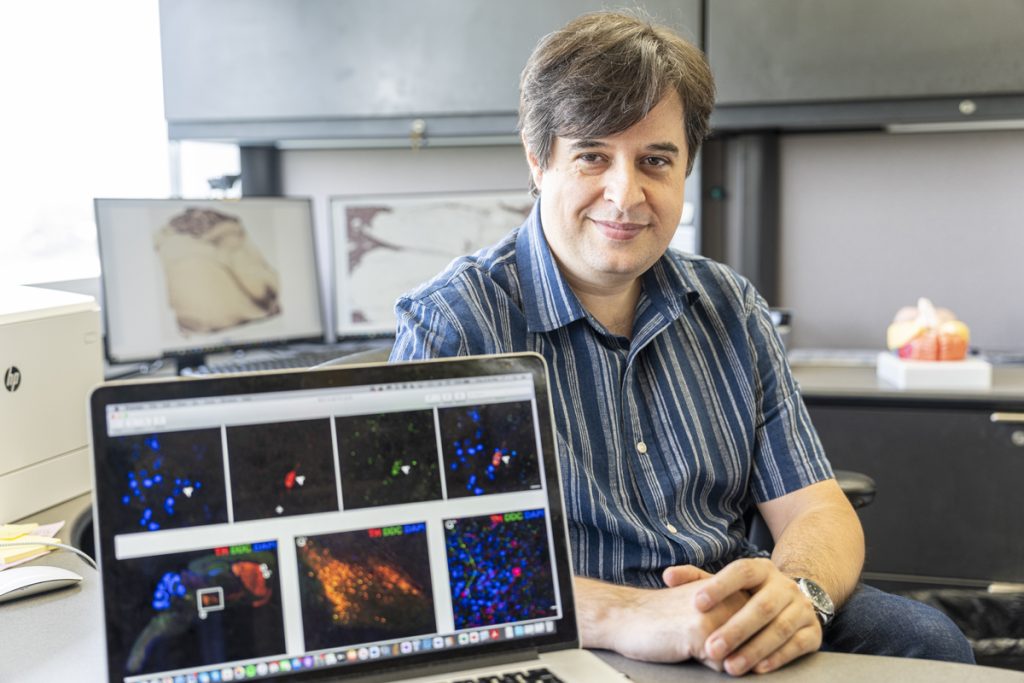
Throughout his time studying human brain development, Sousa has been investigating the gene CBLN2, which is crucial to synapse development and function. Synapses are the connections between neurons that allow for communication between cells. He knew that in Down syndrome, a genetic condition resulting from a triplicated 21st chromosome, there are often deficits in synapse number and structure.
“Out of curiosity, I checked to see if the expression of CBLN2 was down regulated in Down syndrome,” Sousa says. “It was and once I started my lab here, we started investigating it a little more. Then during my second year here, I applied for a pilot grant from the Dewey Catalyst Fund to generate more data.”
The Dewey family have been long time supporters of the Waisman Center and the research that the center conducts. Annie, who has Down syndrome, has been participating in research at Waisman for more than a decade. The family decided to gift Waisman with research funds designated specifically to supporting early-stage research in Down syndrome. Sousa was one of the first recipients of the fund.
The data that Sousa and his lab collected with support from the Dewey Catalyst Fund is what made it possible for him to apply for this new grant from the NIH. The new grant gives Sousa the opportunity to dig deeper into synaptic deficiencies in Down syndrome and investigate further the role of CBLN2 in synapse function and development. “We are really trying to understand the underlying molecular mechanisms of these deficiencies,” Sousa says.
The project will bring together expertise from across the Waisman Center, including collaborations with Waisman investigators Anita Bhattacharyya, PhD, associate professor of cell and regenerative biology, and Qiang Chang, PhD, professor of medical genetics and neurology and Waisman Center director.