
Neighborhood disadvantage is associated with differences in early brain development
By Charlene N. Rivera-Bonet | Waisman Science Writer

At a Glance:
- Exposure to neighborhood disadvantage is associated with measures of lower white matter maturity in infants and children.
- The study, from the lab of Doug Dean III, PhD, showed that greater neighborhood disadvantage was associated with reductions in a MRI measure sensitive to myelin content in brain regions related to executive function, emotion regulation, learning, and adaptive behavior across development. These associations were stronger in infants.
- These results suggest that environmental factors, such as those captured by neighborhood disadvantage measures, are relevant to healthy brain development
The quality of the neighborhood a child lives in may influence the way their brain develops, a new Waisman Center, University of Wisconsin–Madison study suggests. The study highlights associations between neighborhood disadvantage and an MRI measure of myelin maturation, a marker of brain development, across infancy and childhood.
Late gestation to early childhood is a critical window for brain development. It is a period where the brain is highly malleable and its development is heavily influenced by the environment, including household stability, neighborhood safety, and access to socioemotional and cognitive support. The study, from the lab of Doug Dean III, PhD, associate professor of pediatrics and medical physics, sought to understand how neighborhood disadvantage influences the brain during this critical window in infants and children.

Greater neighborhood disadvantage has been associated with differences in academic achievement and socioemotional functioning, including diminished vocabulary development and greater risk for mental health conditions. The researchers used the Area Deprivation Index (ADI) as a comprehensive measure of neighborhood disadvantage that captures factors including income, education, housing quality, and employment.
The study included infants and children from ages 3 months to 11 years who underwent magnetic resonance imaging (MRI) of the brain. A myelin-sensitive MRI technique, developed by Waisman investigators Andy Alexander, PhD, and Steve Kecskemeti, PhD, allowed the researchers to measure myelin content to assess white matter maturity. “It is a more novel approach to imaging that allows us to measure detailed brain features and do more innovative types of studies,” Dean says.
Myelin is a fatty substance that helps insulate the white matter in neurons, allowing for faster communication between the cells. “Myelination occurs rapidly early in life, and it’s an activity- and exposure-driven process. Different activity, stimulation, or environmental factors are going to help drive that process,” Dean says. Early in life, myelin has been associated with outcomes such as cognitive function, school readiness, and language development. “Myelination supports the processes that we know are really important to help kids grow and interact with their environment,” explains Leela Shah, neuroscience graduate student in Dean’s lab and first author of the study.
Results showed that higher ADI, or greater neighborhood disadvantage, was associated with reduced myelination in white matter regions of the brain involved in executive function, emotion regulation, learning, and adaptive behavior. These associations were strongest in infancy, a period of development with rapid white matter growth.
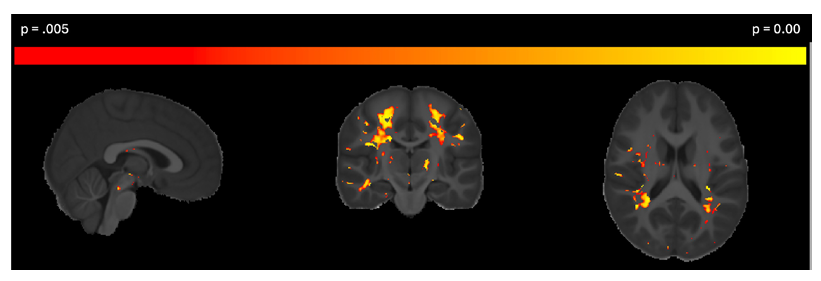
Controlling for household income and maternal education did not change this association, which suggests that the associations seen do not just represent family-level access to resources, but may more broadly represent neighborhood qualities. “The relationship between neighborhood disadvantage and myelin measures could be capturing factors like access to resources, educational opportunities, and safe environments,” Shah explains. “There are a number of different contextual factors which could be driving this relationship that would take future studies to further clarify.”
“When we think about how to best optimize development and how to promote policies to support healthy brain development, this work is another way to highlight that that these factors do matter.”
These results, the authors clarify, do not mean that all kids who grow up in disadvantaged neighborhoods will have altered brain development, but it highlights the importance of resilience measures and positive supports that can buffer those effects. Future studies from the Dean lab will look into resilience factors that may protect against the negative environmental effects. “Factors like caregiving, access to education, and policies that really help uplift communities may help promote child brain development,” Shah says. “When we think about how to best optimize development and how to promote policies to support healthy brain development, this work is another way to highlight that that these factors do matter.”