
A dynamic map of early brain development captures major drivers of neurogenesis
By Charlene N. Rivera-Bonet | Waisman Science Writer
At a Glance:
- A new computational resource can capture major drivers of neurogenesis using single-cell data.
- The tool, developed by the labs of Daifeng Wang, PhD, and André Sousa, PhD, provides a comprehensive cross-species and cross-regional atlas of how genes work together through early brain development.
- The resource is freely accessible through an interactive online platform.
A map of early brain development that captures its major drivers and their dynamics through time has been developed by Waisman Center investigators. Compiling different brain regions across three different species including humans, the new blueprint can identify the upstream regulators of brain development, evolution, and disorder risk, revealing how highly complex and coordinated brain development is.

In this new study, published in Genome Biology, the researchers created a computational resource that can identify how genes work together and how their interactions change dynamically during the formation of neurons – or neurogenesis – and whether these changes are conserved across species or human specific. The study was led by Daifeng Wang, PhD, H.I. Romnes Associate Professor of Biostatistics & Medical Informatics and Computer Sciences, and André Sousa, PhD, associate professor of neuroscience.
Neurogenesis is a highly complex and dynamic process that varies depending on developmental timepoint, brain region, and cell type. This allows for neural circuits to perform different functions based on where in the brain they are located. The goal of this new framework was to characterize how groups of genes – rather than individual genes – work together through different timepoints of development to guide neurogenesis, and to identify the unique developmental paths of each brain region.
“Instead of looking gene by gene at 20,000 genes, this approach tries to identify groups of genes that act together to drive these processes, and then we can identify the upstream regulators of brain development, evolution, and disease,” says Ryan Risgaard, PhD, former graduate student in Sousa’s lab and co-first author of the study.
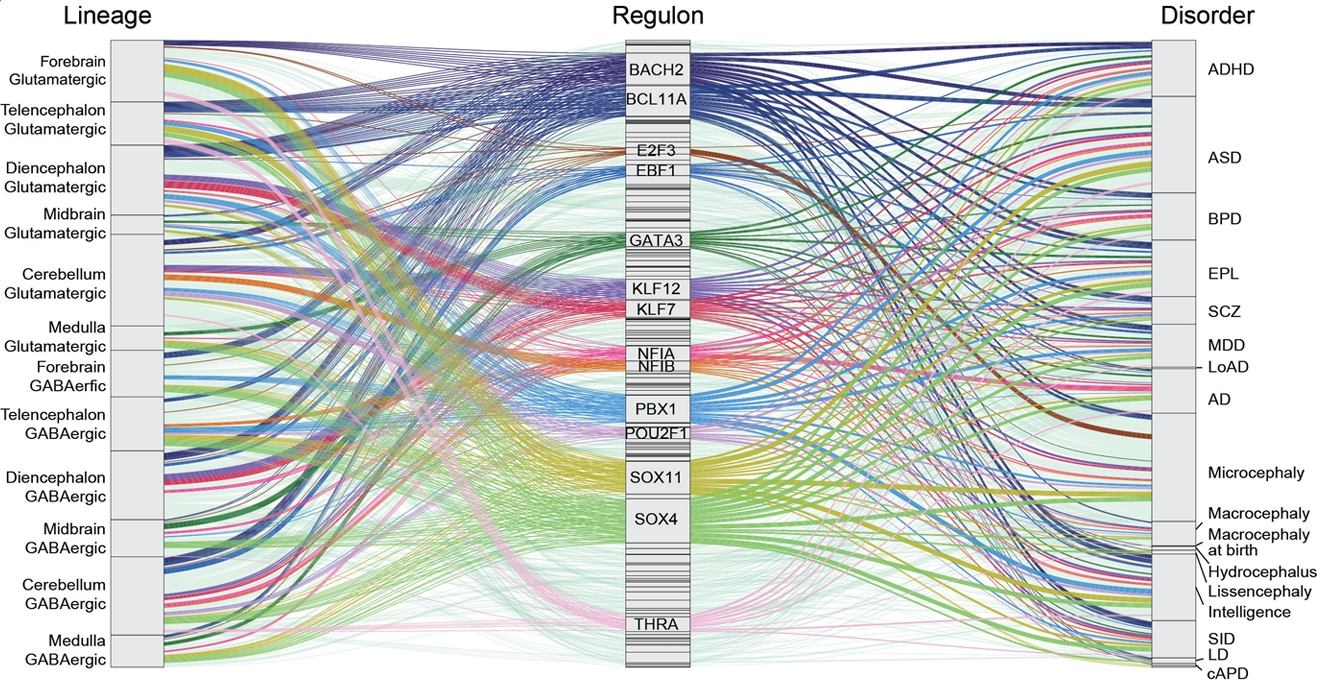
Using single-cell genetic data, they constructed a computational resource including the lineage of 20 human neuron types from three brain regions that collectively represent the whole human brain, along with four neuronal lineages from mice and macaque. “We were trying to figure out what differences we would see in terms of gene regulation when generating these different types of neurons,” says Kalpana Hanthanan Arachchilage, PhD, postdoctoral fellow in Wang’s lab and co-first author of the study. “What we did is we identified, let’s say if you’re creating a neuron from the prefrontal cortex, this is how the path goes. If it is in a different brain region, it’s a different path, and the different regulatory mechanisms are changing [at different stages of neurogenesis],” he explains.
After identifying groups of genes that work together to drive neurogenesis, the researchers were able to pinpoint upstream regulators, or transcription factors, that control the expression of those groups of genes involved in early brain development. They then biologically validated their function.

“We chose [ILF2] because there wasn’t much known and we could be showing something novel, and that’s essentially what we did,” Risgaard says. After computationally discovering ILF2 as a novel gene regulator involved in neurogenesis, they knocked it down in human brain organoids – clumps of cells that closely mimic the human brain – discovering a dysregulation of downstream expression of genes essential for neurogenesis.
Comparing neurogenesis across three different species, humans, mice, and macaques, revealed both genetic pathways that are shared, and pathways that are unique to human neurodevelopment. “It’s really important to understand that, not only for understanding human potential vulnerability to disorders, but also how can we study and model this gene in other species?” Sousa says. “Because sometimes it’s super conserved, but a lot of times, almost always, although they are conserved, there’s always human-specific biology behind it that we need to understand.”

This is particularly important when using animal models to study human disorders.
Lastly, the researchers mapped disease-associated genes to the computational tool to characterize gene dynamics of 30 neurological disorders and traits, including autism spectrum disorder, schizophrenia, intellectual disability, and microcephaly.
This atlas is freely available online for anyone to use.
The creation of this tool was made possible by the collaboration of the Wang and Sousa labs, bringing different, but complementary expertise. “Our lab develops computational tools to uncover patterns in large-scale genomic data, while the Sousa lab brings expertise in biology and brain development to guide both the analysis and its pattern interpretation,” says Wang. “Over more than two years, this collaboration has helped both teams learn from each other and make more meaningful discoveries.”