
Emotions News
-
Early adversity strongly predicts adult mental health challenges in people with Down syndrome, new study finds
A new Waisman study found that adverse childhood experiences (ACEs)—such as abuse, neglect, or exposure to household challenges—can have lasting effects on adults with Down syndrome, including their mental health and ability…
-

Childhood maltreatment leads to flattened cortisol rhythms in adolescence, a costly adaptation to an adverse environment
Adolescents who experience sustained childhood maltreatment show high, inflexible cortisol levels that persist throughout the day in different social contexts, a new study shows. This flattened cortisol rhythm may be a pathway…
-

Kids who feel their parents are less reliable take fewer risks vital to learning and growth
Trying something new is a risk every child undertakes as they explore and learn about the world. While risk can be costly, it can also pay off in rewards or knowledge.
-

Seth Pollak: A career dedicated to understanding child emotion
The fun decals on the colorful walls and the cheerful environment gives it away, the third floor of the Waisman Center is dedicated to children. This space is where Seth Pollak, PhD,…
-
In new book, leading neuroscientist describes your brain on emotion
Building on more than 30 years of cutting-edge brain research, a new book by Richard J. Davidson offers an inside look into how emotions are coded in our brains and our power…
-
How does the compassionate brain, measured in the lab, predict what occurs in real life?
Researchers are launching a new series of studies to understand how laboratory measures of virtuous qualities such as compassion relate to their behavior in the real world.
-
The science of healthy minds brings Dalai Lama to UW–Madison
The Center for Investigating Healthy Minds at the University of Wisconsin–Madison’s Waisman Center will welcome His Holiness the 14th Dalai Lama to its public grand-opening celebration Saturday-Sunday, May 15-16. UW–Madison neuroscientist Richard…
-
Expectant Brains Help Predict Anxiety Treatment Success
A network of emotion-regulating brain regions implicated in the pathological worry that can grip patients with anxiety disorders may also be useful for predicting the benefits of treatment.
-
$6 Million Grant Creates Meditation Study Center
Research at UW–Madison has already shown that meditation can change the brain. Now a new grant will allow a more in-depth investigation of how these changes can affect sleep, pain tolerance, emotion…
-
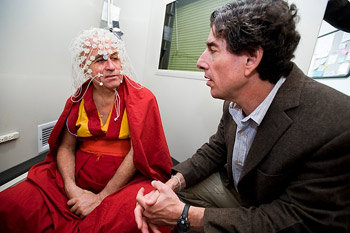
Can love change your mind? New project explores neuroscience of ‘positive qualities’
By Brian Mattmiller, University Communications What is happening in the minds of people who have developed a greater capacity for forgiveness and compassion? Can a quality like love — whether it’s shown toward…
-
Scientists study links between brain, meditation
Meditation matters. Brain scientists are using the age-old practice to understand stress and pain reduction, attention spans, even compassion.
-
Study shows compassion meditation changes the brain
Can we train ourselves to be compassionate? A new study suggests the answer is yes. Cultivating compassion and kindness through meditation affects brain regions that can make a person more empathetic to…
-
Brain Storm
The building is locked. Most of the windows are dark. But in a small room on the first floor of the Waisman Center, a group of four is gathered around Richard Davidson.
-
Research of Richard Davidson shows how meditation changes the mind
By Dave Tenenbaum, University Communications For hundreds of years, Tibetan monks and other religious people have used meditation to calm the mind and improve concentration. This week, a new study shows exactly…
-
Meditation may fine-tune control over attention
Everyday experience and psychology research both indicate that paying close attention to one thing can keep you from noticing something else.
-
Richard Davidson’s research cited: the effect of meditation on brain
In the first scientific article to come from its pioneering studies of long-term Buddhist meditation practitioners, a UW–Madison team has found that long-term meditators (or “adepts”) show markedly different patterns of brain…
-
Serenity Now
The search for happiness can take many paths.
-
Waisman Center Researchers Awarded $10.7 Million Grant for Brain Imaging Research on Emotion
Even though we all experience similar emotions, we respond to them in different ways.
-
Waisman researcher Richard Davidson graces the cover of the winter 2004 issue of the Wisconsin Academy Review magazine.
The article, “The Science of Happiness,” showcases Davidson’s research on the brain mechanisms that underlie emotions. In particular, Davidson has worked with Buddhist Monks, including the Dalai Lama, to document how meditation…
-
Davidson’s Emotion Research Featured in New York Times Magazine
Waisman Researcher Richard Davidson, Ph.D., has been featured in several media stories lately regarding his work with the brain mechanisms that underlie emotions. The most recent is a story in the September…
-
Study shows brain activity influences immune function
Staying healthy may involve more than washing hands or keeping a positive attitude. According to a new study from the University of Wisconsin–Madison, it also may involve a particular pattern of brain…
-
Meditation produces positive changes in the brain
In a small but highly provocative study, a UW–Madison research team has found, for the first time, that a short program in “mindfulness meditation” produced lasting positive changes in both the brain…
-

Orphanage experience alters brain development
During the last decade, many American families have opened their hearts and homes to children adopted from Eastern European orphanages.
-
Brain images reveal effects of antidepressants
The experiences of millions of people have proved that antidepressants work, but only with the advent of sophisticated imaging technology have scientists begun to learn exactly how the medications affect brain structures…